Projects can be overwhelming, especially if they are long and complex. Say you have taken up a vast construction contract that involves plumbing, tiling, civil work, as well as laying the bricks (basically an end-to-end project). There are plenty of phases involved in this project. This can lead to a massive project failure if you don't estimate the time involved or the project basics correctly. It is possible you go overboard with your budget and hit significant overheads for your business. The reasons are plenty-
- You miscalculated the resources involved in the project
- You didn't consider the total labor, phases, or time that this project will take
- You didn't divide the whole project properly
A project manager is responsible for managing the project documentation, handling the costs, and defining the estimates. Bottom-up Estimating plays a pivotal role in operating expenses, whether you are running a small project (changing the tap at a residence) or a complete construction project.
What You'll Learn
- 01How bottom-up estimating breaks down complex projects into manageable tasks
- 02Why this technique improves estimation accuracy and reduces errors
- 03The key differences between top-down and bottom-up approaches
- 04Step-by-step process for applying bottom-up estimating to your projects
- 05Real-world examples of bottom-up estimating in construction and contracting
Table of Content
- The Bottom-up Estimating: An Overview
- Why Use Bottom-up Estimating Technique?
- Better Understanding of bottom-up Estimating With an Example
- Applying Bottom-Up Technique to a Project
- Top-Down vs. Bottom-Up Techniques
- Real-world Application of Bottom-Up Estimating
- Why you should use InvoiceOwl for bottom-up projects
- Conclusion
The Bottom-up Estimating: An Overview
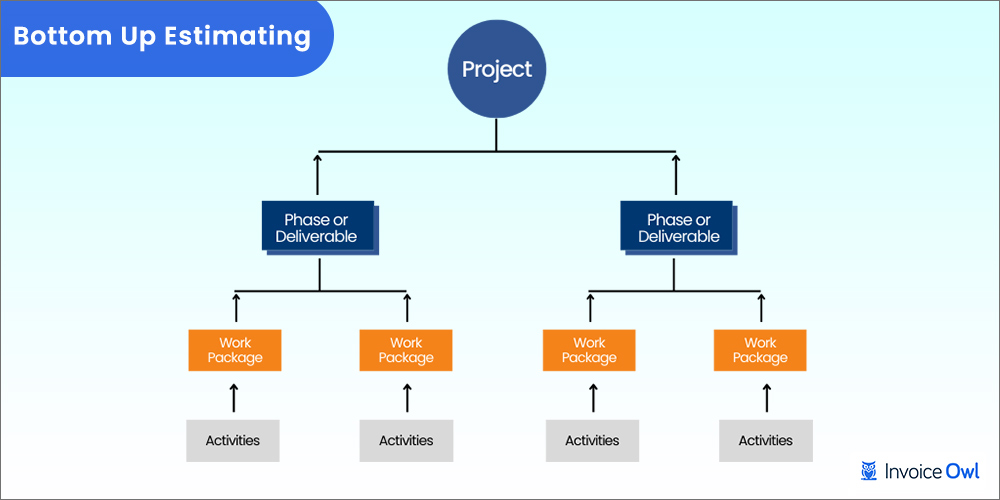
Among the different techniques, the bottom-up estimation technique is quite popular. It helps break down your project into smaller but significant portions, which eventually ensures proper budgeting. Using this technique lets you know how to delegate the work, determine the timelines, and detail out timelines with greater accuracy. The estimate of the whole project is the sum of the granular estimates. This means the approximation you did concerning cost and time will be considered when delivering the total guesstimate for the project.
Why Use Bottom-up Estimating Technique?
When several estimation techniques are available, why should you go with bottom-up? Here, we will discuss the several benefits associated with this methodology.
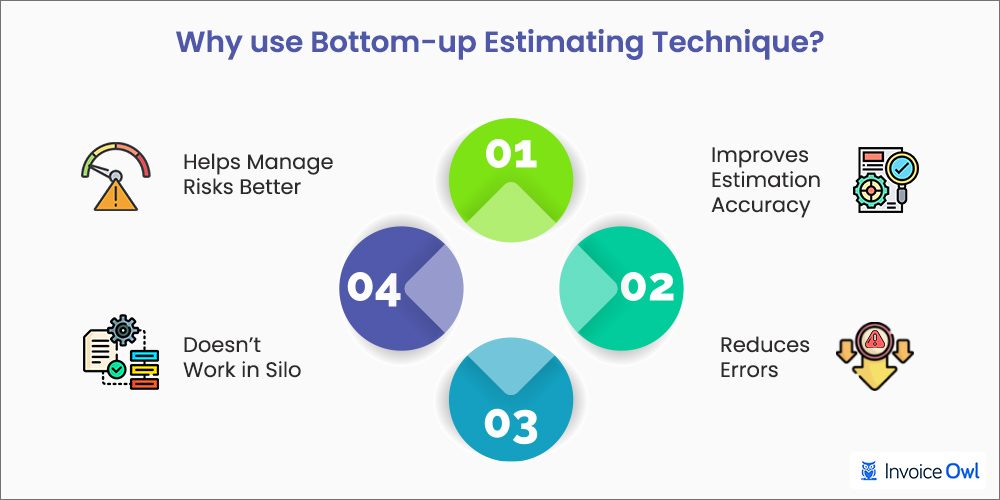
Improves Estimation Accuracy
When you are segmenting the project, there are several aspects that you need to consider. Breaking down the project into various phases and parts will also help you define the scope. However, it is challenging to identify the exact budget, resources, and timeline for any project. With this methodology, you will determine the exact phases and elements involved in completing the project. You will know what things you need to consider to complete the project successfully. For example, you are considering a full-contracting construction project. In that case, you need to include the brickwork, the interior lining, the plumbing, and the painting. Each component is a separate phase and needs to be done differently. Moreover, you will need specialists for each phase. With this estimating method, you will predict the roadblocks better and create an all-inclusive work package. You will take note of key elements that will help you define the work scope and enable you to empower your resources.
Reduces Errors
When estimating a project, chances are you miscalculating the scope or the cost of a particular phase. If you were estimating using other methods, you have limited flexibility to address these mistakes or remove them. However, with the bottom-up method, you check what you can do with an error, conduct a cost-benefit analysis post the error has been made, and identify ways to nullify it. The best part is you can do it over the entire project's lifecycle. You can keep making the necessary adjustments to the cost and delivery timelines, thus ensuring your project cost or timelines are not affected. In this way, you never go over budget and can manage your scope within the timeline defined.
Doesn't Work in Silo
The best part about this technique is that you can use it with several other methods. For instance, if you feel that the timelines are best identified using the parametric approach, you can use that first and combine it with bottom-up results. This way, both the cost and timelines are defined for the project in the most seamless manner. The flexibility you get with this project estimation technique is higher than others. When you integrate it with different techniques, you empower your team members more and improve the overall effectiveness of the results. It also helps determine a more efficient strategy for project management.
Combine bottom-up estimating with parametric or analogous methods for even more accurate project predictions. The flexibility of this approach makes it easy to integrate with other techniques.
Helps Manage Risks Better
You are much better when you have determined the budgets and the overall scope. You have also identified the risks involved and know how best to tackle them. You know what to expect when the project goes on the floor. It also helps connect with the right teams or people. It also helps ensure that the whole task moves along the team. You don't have to depend on a single person or their ability to manage the entire project. Eventually, you are better positioned to manage the risks and handle the different situations.
Better Understanding of bottom-up Estimating With an Example
The example stated will clarify the understanding of what Bottom-up estimating is. As you know bottom-up estimating method is about breaking down the project into smaller elements. With an example, you will get a better understanding of the estimating method. The work required five contractors for 10 days. The manpower demands 15 USD per day. Apart from this, there is an additional manpower requirement that includes 3 engineers that cost 10 USD per day for 3 days. The calculation consists of: (51015) + (3103) = 840 The manpower, time, and cost allocation are completed. But there is some problem with the technology and utilization. Since there is a risk involved, let's add 10 USD to the project as a contingency reserve to overcome the problem if piles up. This reserve is considered to be a rescue when any identified risk pops up. On top of it, add 10% of the project cost as a management reserve. You can use the reserve when some unidentified risk comes up for which you are unprepared. So, the calculation of management reserves goes like this: MR = 10% of (840 + 10 Contingency Reserve) = 10% of 850 = 85 The total project cost sums up to around 840+10+85 = 935.
Bottom-Up Cost Calculation Breakdown
| Component | Calculation | Cost |
|---|---|---|
| Contractor Labor | 5 contractors × 10 days × $15/day | $750 |
| Engineer Labor | 3 engineers × 3 days × $10/day | $90 |
| Base Project Cost | Contractor + Engineer Labor | $840 |
| Contingency Reserve | Risk mitigation buffer | $10 |
| Management Reserve | 10% of (Base Cost + Contingency) | $85 |
| Total Project Cost | All components combined | $935 |
Applying Bottom-Up Technique to a Project
It is now crucial to understand how to implement this project management technique in real-world calculations. There are several steps involved, and we will discuss these in detail.
Define the Tasks
The first step in this technique involves listing all the different project elements that you need to tackle. For instance, if a project consists of goods or getting the bill of material, you should define that task. You need to create a work breakdown structure to divide your entire project into efficient and straightforward tasks. This will help you look at the project from a granular level and determine the most important aspects and people.
Timelines and Resource Definitions
In the previous step, we mentioned that if you need to prepare a bill of materials, you should mention that in the scope. At this point, you will need to say the person in charge of creating the BoM and the total time it will take to complete this. Similarly, you will need to mention the same for all the tasks involved in a project. It will help you identify how many resources you will need through the project and timelines to consider. It will help you define the overall project length and the total labor.
Determine the Allocations
Once you are done estimating the time and scope, it is now time to delegate the tasks and empower your employees. Now is the time when people are involved in creating the project estimation. You will need to get people to talk about the infrastructure cost, the overheads involved, and the technology defined for each project task or phase. This will improve the granularity of the project definition and help the project managers get a more in-depth insight into the estimate. It will also ensure that nothing circles back to the project manager; everyone determines the overall cost and resources for their particular area of expertise.
Top-Down vs. Bottom-Up Techniques
You are now more than aware of how bottom-up works. Let's take a look at how it differs from top-down.
- The first crucial difference is how the project is broken down into phases. In the bottom-up technique, the estimate is a sum of more minor phases. You solve smaller problems throughout the project and then sum them up to create the entire solution. on the other hand, you break each issue into smaller portions top-down and then try to solve them individually.
- There isn't inter-module communication for top-down while it is mandatory for bottom-up.
- You can use bottom-up with other techniques; however, this may not be the case for top-down.
- The top-down approach is the best fit for an overview of estimates; however, if you want to get a more detailed insight, you might go for a bottom-up approach.
Top-Down vs. Bottom-Up Comparison
| Aspect | Bottom-Up Estimating | Top-Down Estimating |
|---|---|---|
| Approach | Sum of smaller phases to create total estimate | Break down overall estimate into smaller portions |
| Communication | Requires inter-module communication | Limited inter-module communication |
| Flexibility | Can combine with other techniques | Less flexible for integration |
| Detail Level | Highly detailed and granular | High-level overview |
| Best For | Accurate project cost estimation | Quick initial estimates |
| Time Required | More time-intensive | Faster to implement |
Real-world Application of Bottom-Up Estimating
Let's say you are working on a fencing project, which involves setting up the land for fencing, buying the fencing material, and the actual labor. You will need to calculate the actual cost of buying fence posts and setting them up. If you set up 20 posts to cover the entire place, you will need to multiply the per post cost by the total posts. You checked with a person who recently completed this project and the local store that sells the requisite hardware. One said the total cost comes to around $50 per post, which means you will need to invest $1000 for the entire project. When you connected with the person who got it done recently, they told you the project cost them around $3000. They just told you the total cost of labor and other aspects. You got a parametric and analogous estimate on hand. When you granularize the two, you get a bottom-up estimate. You use the total cost of the materials and add it to the total cost of labor and service to get your bottom-up estimate. You don't look at one aspect alone. There are several applications across industries for bottom-up. You can either sit to work through bottom-up from scratch or depend on other estimate approaches to conclude.
For a 20-post fencing project: Materials cost ($50 × 20 posts = $1,000) + Labor and installation ($2,000) = Total bottom-up estimate of $3,000. This combines parametric estimating for materials with analogous estimating for labor costs.
Create Lightning-Fast Estimates With InvoiceOwl
Cut short the time you spend on estimating and invoicing by using InvoiceOwl. Create accurate bottom-up estimates with predesigned templates and autofill data 10x faster.
Start Your FREE TrialWhy you should use InvoiceOwl for bottom-up projects
InvoiceOwl is a featured-pack software with a primary focus on helping its users create agile and accurate estimates/invoices. You can integrate your project, add clients, and line items to get yourself ready for preparing any estimates or invoices that come up. Besides, filing a tax, managing different accounts, and preparing reports automatically is what InvoiceOwl is famous for. The software comes up with different pricing plans that you may choose from as per your requirements. Get the best software for yourself to start creating and sending estimates/invoices.
Frequently Asked Questions
Bottom-up estimating is a project management technique that breaks down complex projects into smaller, individual tasks. Each task is estimated separately for cost, time, and resources, and then all estimates are summed to create the total project estimate.
By breaking projects into smaller components, you can assess each element with greater precision. This granular approach helps identify specific resource needs, potential roadblocks, and accurate timelines that might be overlooked in broader estimation methods.
Use bottom-up estimating when you need detailed, accurate project estimates and have the time to analyze each component. It's ideal for complex projects with multiple phases. Top-down is better for quick initial estimates or high-level overviews.
Yes, bottom-up estimating is highly flexible and can be combined with other estimation methods like parametric or analogous estimating. This integration often leads to more comprehensive and accurate project estimates.
Contingency reserves are budgets set aside for identified risks that might occur during the project. Management reserves are additional funds (typically 5-10% of total cost) for unexpected issues that weren't identified during planning.
InvoiceOwl streamlines the bottom-up estimating process with templates, autofill data, detailed line-item tracking, and automatic calculations. This helps you create accurate, granular estimates faster while maintaining precision.
Conclusion
If you are looking for a more conclusive and highly able estimating approach, you should consider bottom up. It helps identify the different tasks to be done establishing the work before helping with the cost estimates. You would have a defined workflow and know the teams you need to onboard. You can even seek help from the different people involved in the project to improve your estimate's effectiveness. The collaborative approach taken by the bottom-up is one of the many reasons it is efficient, reduces risks, and improves the cost estimating outcome. If you want to ditch the old way of estimating and quoting jobs, then InvoiceOwl is the best estimating and invoicing software, allowing you to create estimates and invoices in one click. Get access to FREE Trial and explore different features and functionalities of the software.
Related Resources

Are estimates free? Know When Can You Charge for Estimates
Are you stuck between deciding whether to offer free estimates or charging a fee for them? Here are the general guidelines for charging for estimates.
Read more
Can You Charge for an Estimate as a Contractor?
Complex projects involving detailed designs and multiple revisions may incur some charges for estimates. Learn when to charge for an estimate as a contractor.
Read more
A Complete Guide on How to Bid on Plumbing Jobs
Want to know how to bid on plumbing jobs in a professional way? Learn how specific plumbing jobs differ and how to calculate pricing in seconds.
Read more
How to Calculate Overhead Cost With 100% Accuracy?
If you are not sure how to calculate overhead cost, here is a comprehensive guide to achieve 100% accuracy and estimate the project better.
Read more
Tips on How to do a Fence Estimate Professionally
Are you a contractor hired to erect a privacy fence or commercial fence? Here's all you need to know on how to estimate a fencing job accurately for profit.
Read more
How to Estimate a Painting Job to Make Profit?
Learn how to estimate a painting job for profit. Tips on pricing, materials, and labor costs to help you make a fair and profitable bid. Read more!
Read more
Tips on How to Estimate Lawn Care
Offering your lawn mowing services at a good rate ensures you earn a decent profit. Learn how to estimate lawn care and price your services competitively.
Read more
How to Price Drywall Jobs: Everything About Drywall Pricing & Estimation
Learn how to price drywall jobs and what factors you should consider as a drywall contractor when estimating drywall costs.
Read moreAre estimates free? Know When Can You Charge for Estimates
Are you stuck between deciding whether to offer free estimates or charging a fee for them? Here are the general guidelines for charging for estimates.
Read moreCan You Charge for an Estimate as a Contractor?
Complex projects involving detailed designs and multiple revisions may incur some charges for estimates. Learn when to charge for an estimate as a contractor.
Read moreA Complete Guide on How to Bid on Plumbing Jobs
Want to know how to bid on plumbing jobs in a professional way? Learn how specific plumbing jobs differ and how to calculate pricing in seconds.
Read moreHow to Calculate Overhead Cost With 100% Accuracy?
If you are not sure how to calculate overhead cost, here is a comprehensive guide to achieve 100% accuracy and estimate the project better.
Read moreTips on How to do a Fence Estimate Professionally
Are you a contractor hired to erect a privacy fence or commercial fence? Here's all you need to know on how to estimate a fencing job accurately for profit.
Read moreHow to Estimate a Painting Job to Make Profit?
Learn how to estimate a painting job for profit. Tips on pricing, materials, and labor costs to help you make a fair and profitable bid. Read more!
Read moreTips on How to Estimate Lawn Care
Offering your lawn mowing services at a good rate ensures you earn a decent profit. Learn how to estimate lawn care and price your services competitively.
Read moreHow to Price Drywall Jobs: Everything About Drywall Pricing & Estimation
Learn how to price drywall jobs and what factors you should consider as a drywall contractor when estimating drywall costs.
Read moreAre estimates free? Know When Can You Charge for Estimates
Are you stuck between deciding whether to offer free estimates or charging a fee for them? Here are the general guidelines for charging for estimates.
Read moreCan You Charge for an Estimate as a Contractor?
Complex projects involving detailed designs and multiple revisions may incur some charges for estimates. Learn when to charge for an estimate as a contractor.
Read moreA Complete Guide on How to Bid on Plumbing Jobs
Want to know how to bid on plumbing jobs in a professional way? Learn how specific plumbing jobs differ and how to calculate pricing in seconds.
Read moreHow to Calculate Overhead Cost With 100% Accuracy?
If you are not sure how to calculate overhead cost, here is a comprehensive guide to achieve 100% accuracy and estimate the project better.
Read moreTips on How to do a Fence Estimate Professionally
Are you a contractor hired to erect a privacy fence or commercial fence? Here's all you need to know on how to estimate a fencing job accurately for profit.
Read moreHow to Estimate a Painting Job to Make Profit?
Learn how to estimate a painting job for profit. Tips on pricing, materials, and labor costs to help you make a fair and profitable bid. Read more!
Read moreTips on How to Estimate Lawn Care
Offering your lawn mowing services at a good rate ensures you earn a decent profit. Learn how to estimate lawn care and price your services competitively.
Read moreHow to Price Drywall Jobs: Everything About Drywall Pricing & Estimation
Learn how to price drywall jobs and what factors you should consider as a drywall contractor when estimating drywall costs.
Read more