

Key Takeaways
- 01A profitable lawn care estimate starts with your real numbers: overhead per job, fully loaded labor cost, and materials — then profit margin on top
- 02Measure the property (Google Maps works for most residential lots) and adjust your square-foot baseline for slopes, gates, obstacles, and lawn condition
- 03Seasonality is a cost: overhead keeps running through winter, so your in-season prices must carry the slow months or you need off-season services like snow removal
- 04Price for your market — the same half-acre lawn can command very different rates depending on region, climate, and local competition
- 05Quote add-ons (haul-away, edging, fertilizing, cleanup) as separate line items instead of absorbing them into your base price
To estimate a lawn care job, work from the ground up: add your overhead cost per job, your labor cost for the hours the property will take, and any materials — then apply the profit margin your business needs. Size and condition of the lawn set the hours; your region and season set what the market will bear.
The demand is there. IBISWorld put the U.S. landscaping services industry at roughly $189 billion in 2025, spread across more than half a million businesses — which also means plenty of competitors quoting against you. Guess at your prices and you either leave money on the table or win jobs that lose money.
Here are the eight factors that turn a guess into a defensible lawn care estimate.
How to Estimate Lawn Care Pricing
There is a need to emphasize the pricing as it can play a crucial part in ensuring that your target audience chooses you over other landscaping companies in the area. So how can you determine the estimation for lawn care businesses? What influences the lawn care pricing for your business?
To shed more clarity, here are eight factors that help you estimate the lawn care prices:
1. Calculate Overhead Costs
The first and foremost way that helps you estimate the price for your lawn care services is by looking after the overhead costs. As a business owner, you should be as clear as possible with your operational costs to ensure that you do not harm your profit margins by having to cover your operating expenses.
You must calculate the overhead cost of your business and figure out what your real expenses are to establish a more profitable and scalable pricing point for your business.
It's essential to take a variety of factors into account when determining the overhead lawn care cost for your business, including equipment, technology, business insurance, office space, and employee or labor costs.
As soon as you have calculated your overhead costs, choose an average number of lawn care projects per month that you can handle to generate the overhead cost per job by dividing your overhead costs by the number of lawn mowing services and maintenance projects you can handle in a month.
This is the cost of supplying service for a particular lawn care job, which needs to be included in the price of your service.
2. Factor in Taxes
The overhead cost can also include taxes. However, it is recommended that you pay special attention to business taxes as they are likely to impact your lawn care package.
There are many tax deduction opportunities that independent contractors can take advantage of to reduce their tax liabilities. Tax deductions are available for everything you purchase, from the miles you drive to the equipment you buy.
Your expenses can be included in your tax filing, thus minimizing the tax amount you must pay to the government and helping you reduce your taxable income.
You must ensure that you are recording everything and verifying that there are no discrepancies or errors in maintaining records during the auditing process.
3. Consider Weather Conditions
Another important way to estimate the lawn care service pricing is to see the weather conditions. As a part of the lawn maintenance business, it is also essential to mention that there tends to be a cyclical pattern.
In this industry, there is an upward trend in spring and summer but a significant dip in the fall and winter, so consider that when calculating your costs.
To determine your business prices, the weather can play an important role which is often underestimated. Although contractors who serve in cold climates can face a shortage of service work due to a lack of work, the overhead costs will remain most of the time.
Depending on your business type, you should ensure that you winterproof your company to channel your peak season profits to your low season to sustain, scale, and grow your business in the long run.
Several lawn care professionals add snow removal or other off-season services in the winter to ensure that their business remains profitable — there are plenty of ways to make money in winter as a landscaper.
4. Evaluate Location Impact
The price of lawn services can differ significantly from one region to another and from one state to another. So the most significant way to determine the estimation for your lawn care cost is by considering the locality.
A lawn care professional located in an area with consistent climatic conditions all year round will have a lower lawn care price than a lawn care service that provides service in a region where there are fluctuations in seasons. In that case, you need to get equipment depending on the seasons.
Depending on where you are operating in the country, you will need to make sure that you offer different prices depending on the effort involved in operating in the other regions of that country.
5. Account for Labor Costs
To manage the salaries and the aspects of running a lawn care crew, you will have higher overhead costs as the crew is bigger. To accurately price your lawn care services, you need to make sure that you have calculated the cost of managing your crew — a free labor cost calculator helps you get a fully loaded hourly rate that includes wages, payroll taxes, and benefits, not just base pay.
If you plan on how to estimate lawn care services for a customer, you should include the employee's service cost as part of the estimate to let them know how much the human resources will cost them throughout the course of the project.
As a result, you must analyze these factors and find a formula you can use to calculate a more accurate and foolproof lawn care service pricing figure for your customers, which will ensure that your services and pricing brackets are created appropriately.
When your customers realize that the price you charge in return of offering and they find it worth the value, they will be more likely to choose you over the substandard lawn care professionals in your area.
6. Determine Profit Margin Needed
There was already some discussion about overheads and the importance of understanding the figure you need to reach every month. After you have determined this number, the next way to estimate the lawn care pricing is the profit margin that works best for determining the lawn care costs.
An organization's profit is the amount of money left over after all of the overhead, supplies, and labor have been paid for. To better understand the standards in your area, it is recommended to check with the regional trade associations, and to sanity-check your numbers with a profit margin calculator. For a deeper look at what healthy margins look like in this trade, see our guide to lawn care profit margins.
When figuring out what pricing model will be profitable for your business, look at what your competitors are doing.
Say a ¼-acre residential lawn takes one person 45 minutes including trimming and blowing:
- Labor: 0.75 hours × $40/hr fully loaded rate = $30
- Overhead: $3,200/month ÷ 160 jobs = $20 per job
- Materials (fuel, trimmer line): $3
- Cost per visit: $53
- At a 25% profit margin: $53 ÷ 0.75 ≈ $70 per visit
These numbers are illustrative — plug in your own costs. The point is that every dollar in the price is accounted for, so you can defend it when a customer asks why you charge more than the kid next door.
7. Add Additional Services and Materials
After you have estimated the cost of your service based on the client's property size and conditions, ensure that you add in any additional costs you incur for services or materials outside your typical offerings.
In some instances, you might be asked by a client to use sustainable materials that cost more than traditional materials. Additionally, they may ask you to haul away leaves, dig a hole, or clear away brush and debris from the area.
As you prepare your lawn estimate, consider adding additional services or optional work that may enhance the quality of the work.
8. Analyze Property Size and Condition
The next thing you need to do before making a lawn care estimate is to know how large the lawn is and to assess its condition to make a proper estimate. This is particularly important when working on a job requiring new supplies to be purchased.
As an example, in order to estimate a fertilization or weed control job, you need to know the area of the lawn, so you will learn how much fertilizer and other products you need to purchase.
To meet your customers' expectations, use professional tools to ensure your business is efficient and has few errors. If you're falling behind in determining the estimation for the labor cost, estimating software like InvoiceOwl can help you build itemized, professional estimates for your lawn care business in minutes and reuse them job after job.
Methods to Assess Client Property
A couple of methods can be used to assess the property of a client:
- Typically, residential lawn jobs are measured using Google Maps to determine the lawn size.
- When you're speaking with your customers over the phone, ask them what their lawn's condition is, and if they have any specific needs, or ask them to input that information into your online booking form, so you have all the information you need.
Make sure you start by using the square foot pricing on your pricing sheet as a guideline. Once you've gathered detailed information about the property, you can adjust the price accordingly. When you're ready to send it, a free estimate generator or a ready-made landscaping estimate template saves you from rebuilding the quote from scratch every time.
When you have determined that the job requires additional services and materials:
-
Calculate these costs just like you would when you were figuring out the cost of your project. It is essential to value how long each task will take, how much labor you will need, and how much it will cost to purchase the materials.
-
When you inspect, take pictures of areas on the client's property that require more work. The images allow you to demonstrate to your client why an addition or product is included in the package.
Conclusion
Keeping a pricing chart and staying on top of lawn care pricing trends will help you make more money in your lawn care business. This is an ongoing process, and there is no particular way to select the best lawn care services prices, so you will have to go through trial and error before landing on the proper pricing. If you serve office parks or HOAs, commercial work has its own math — see our guide on how to price commercial lawn care.
A great way to ensure your lawn care estimate calculator is customized according to the lawn's needs is to start adapting to invoicing and estimating software like InvoiceOwl. This tool can help you determine your pricing and profit margins. You can even keep track of your expense, and there will be no fear of missing out on payments.
Also, ensure you revisit your pricing quarterly or annually to get feedback from your clients on the pricing.
Get Rid of Paper-based Estimates and Invoices
InvoiceOwl is here to help you with creating professional-looking estimates and invoices for your lawn care business! Convert estimates into invoices in a single click and discover exclusive features.
Start Your FREE TrialFrequently Asked Questions
Prices vary widely by region, lot size, and what's included, so treat any national figure as a rough guide. Published cost guides generally put a standard residential mowing visit somewhere between $50 and $200, with most jobs landing near the middle of that range. Larger properties, overgrown lawns, and bundled services (edging, fertilizing, cleanup) push the price up. The reliable way to set your own rate is the cost-up math in this guide, not someone else's average.
Measure the lawn (Google Maps works for most residential lots), estimate the hours it will take, and price it as labor + overhead per job + materials, plus your profit margin. Established companies with trucks, uniforms, and insurance rightly charge more than informal operators — those overheads are real costs the price has to cover. Put the quote in writing as an itemized estimate so the customer can see exactly what they're paying for.
Most residential mowing is quoted as a flat per-visit price derived from square footage, because customers want to know the total up front. Hourly pricing makes more sense for unpredictable work like overgrown-lot cleanups or landscaping projects where the scope is hard to pin down. Either way, do the math from your costs first — a flat price is just your expected hours priced out in advance.
When a lawn care business starts, most invoices are printed, handwritten, and mailed after the service is completed. Investing in lawn care software such as InvoiceOwl is crucial to keeping finances organized and getting accurate pricing estimates for your customers. It simplifies the process of receiving payments from customers.
Related Resources
12 Best Snow Removal Business Software to Consider This Season
Snow removal business software helps organize operations, estimate costs, invoice, and receive payments all in one place to impress customers.
Read more
Are estimates free? Know When Can You Charge for Estimates
Are you stuck between deciding whether to offer free estimates or charging a fee for them? Here are the general guidelines for charging for estimates.
Read more
Can You Charge for an Estimate as a Contractor?
Complex projects involving detailed designs and multiple revisions may incur some charges for estimates. Learn when to charge for an estimate as a contractor.
Read more
How Much to Charge for Snow Removal: A Complete Guide
Don't have an ideas on how to charge your clients for your snow removal services? We have covered major aspects on how much to charge for snow removal.
Read more![How to Price Landscaping Jobs [7-Step Pricing Plan]](/images/2022/06/how-to-price-landscaping-jobs.jpg)
How to Price Landscaping Jobs [7-Step Pricing Plan]
Create a professional estimate by following the 7-step pricing plan for the landscaping jobs. These steps helps you make effective estimates and gets you more clients quickly.
Read more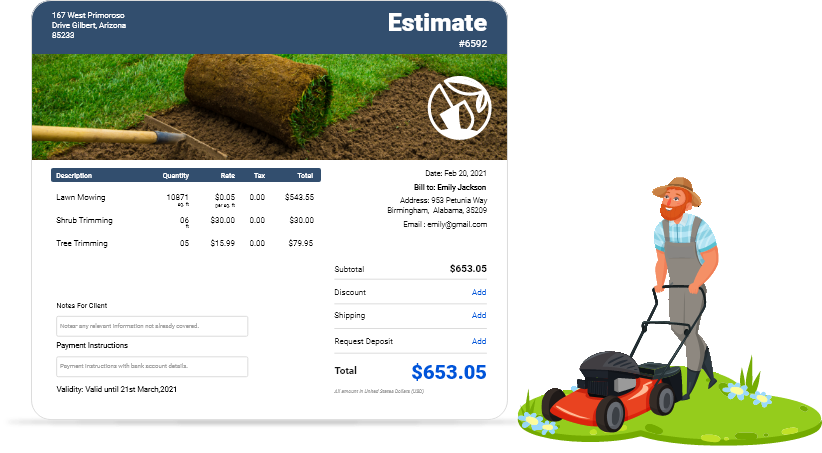
Landscaping Estimate Template
Landscaping Estimate Template
Read moreFree Quotation Template
Use InvoiceOwl free templates to generate instant quotes. Download the required industry-specific free price quote template, feed the necessary details in it, save the document, and then email it to the clients.
Read more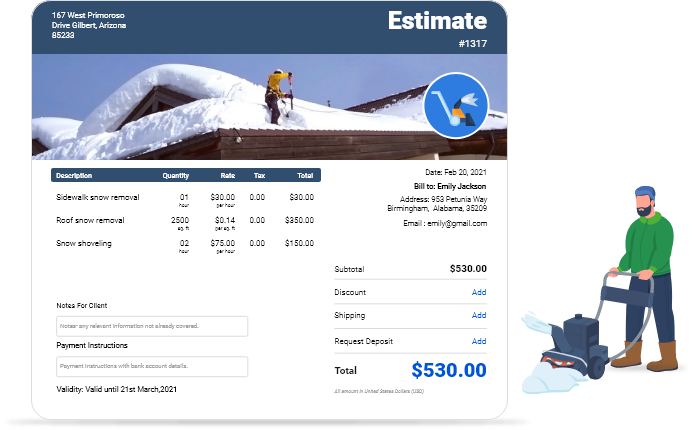
Snow Removal Estimate Template
Snow Removal Estimate Template
Read more12 Best Snow Removal Business Software to Consider This Season
Snow removal business software helps organize operations, estimate costs, invoice, and receive payments all in one place to impress customers.
Read moreAre estimates free? Know When Can You Charge for Estimates
Are you stuck between deciding whether to offer free estimates or charging a fee for them? Here are the general guidelines for charging for estimates.
Read moreCan You Charge for an Estimate as a Contractor?
Complex projects involving detailed designs and multiple revisions may incur some charges for estimates. Learn when to charge for an estimate as a contractor.
Read moreHow Much to Charge for Snow Removal: A Complete Guide
Don't have an ideas on how to charge your clients for your snow removal services? We have covered major aspects on how much to charge for snow removal.
Read moreHow to Price Landscaping Jobs [7-Step Pricing Plan]
Create a professional estimate by following the 7-step pricing plan for the landscaping jobs. These steps helps you make effective estimates and gets you more clients quickly.
Read moreLandscaping Estimate Template
Landscaping Estimate Template
Read moreFree Quotation Template
Use InvoiceOwl free templates to generate instant quotes. Download the required industry-specific free price quote template, feed the necessary details in it, save the document, and then email it to the clients.
Read moreSnow Removal Estimate Template
Snow Removal Estimate Template
Read more12 Best Snow Removal Business Software to Consider This Season
Snow removal business software helps organize operations, estimate costs, invoice, and receive payments all in one place to impress customers.
Read moreAre estimates free? Know When Can You Charge for Estimates
Are you stuck between deciding whether to offer free estimates or charging a fee for them? Here are the general guidelines for charging for estimates.
Read moreCan You Charge for an Estimate as a Contractor?
Complex projects involving detailed designs and multiple revisions may incur some charges for estimates. Learn when to charge for an estimate as a contractor.
Read moreHow Much to Charge for Snow Removal: A Complete Guide
Don't have an ideas on how to charge your clients for your snow removal services? We have covered major aspects on how much to charge for snow removal.
Read moreHow to Price Landscaping Jobs [7-Step Pricing Plan]
Create a professional estimate by following the 7-step pricing plan for the landscaping jobs. These steps helps you make effective estimates and gets you more clients quickly.
Read moreLandscaping Estimate Template
Landscaping Estimate Template
Read moreFree Quotation Template
Use InvoiceOwl free templates to generate instant quotes. Download the required industry-specific free price quote template, feed the necessary details in it, save the document, and then email it to the clients.
Read moreSnow Removal Estimate Template
Snow Removal Estimate Template
Read more