In an average firm of 100-500 employees, an average of 7 people make the most buying decisions.
Key Takeaways
- 01Information related to differences between PO financing and factoring
- 02Get to know when to select PO financing and factoring
- 03How to qualify and apply for PO financing and factoring?
These individuals handle most of your financial decisions, so you must ensure that you have the best talent for managing your financial department positions.
But when it comes to loans and financial aids required for project completion, purchase order financing and invoice factoring can play a critical role in your contractor business to ensure a smooth cash flow and higher business scalability.
You need to understand purchase order financing and invoice factoring in-depth to ensure that the most responsible individuals of your business handle these business segments.
But which lending option is suitable for your business requirements?
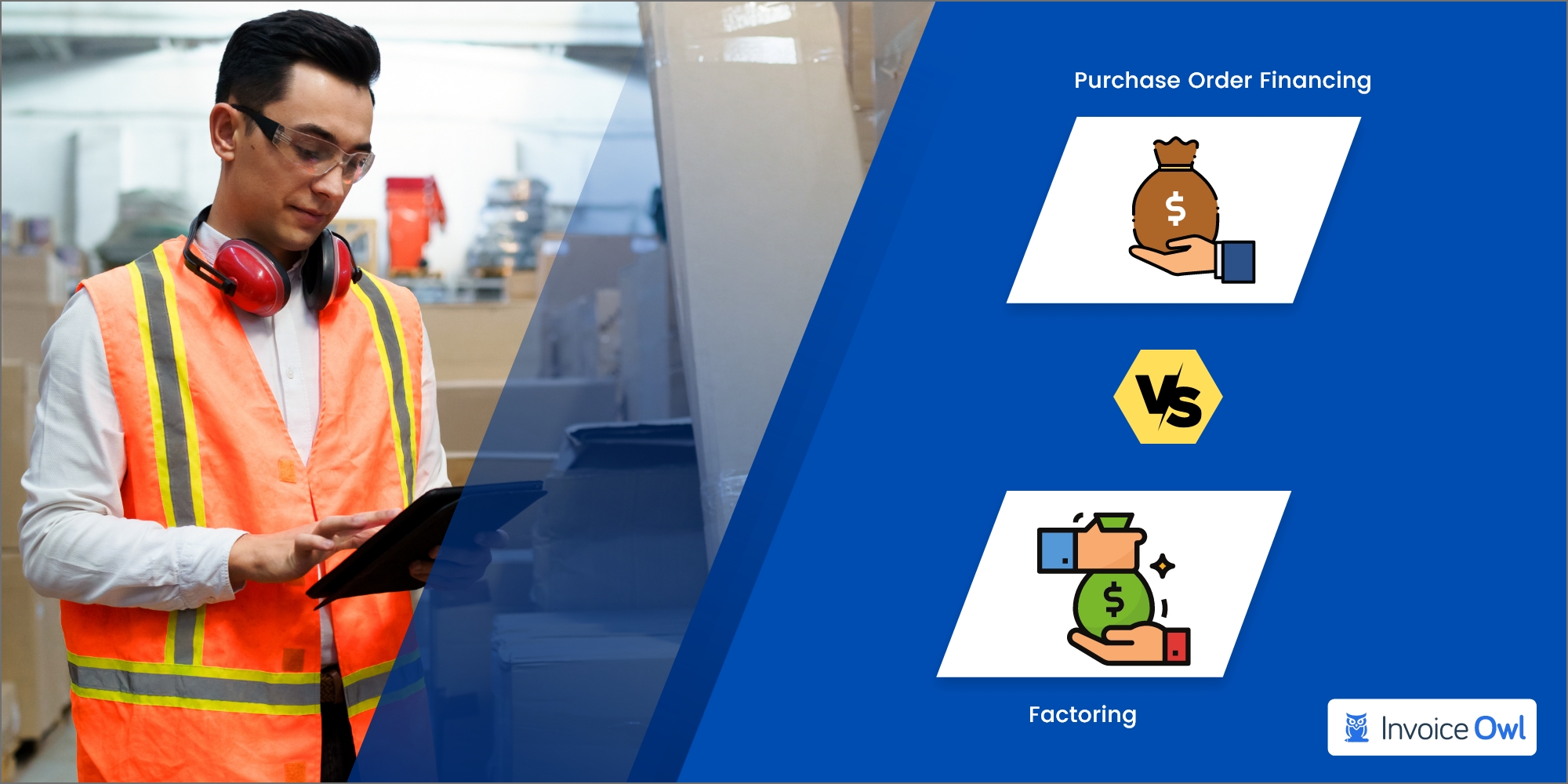
Let's dive deep into understanding the difference between purchase order financing vs. factoring.
Table of Content
- Purchase Order Financing: Meaning, Pros & Cons
- Factoring: Meaning, Pros & Cons
- When Should You Select Purchase Order Financing?
- When Should You Select Factoring?
- Factors Needed to Qualify for Purchase Order Financing & Factoring
- How to Apply for Purchase Order Financing & Factoring?
- FAQ
Purchase Order Financing: Meaning, Pros & Cons
You can secure business loans with purchase order financing that allows your business to purchase necessary materials to help you deliver the desired service to your clients. The financing is common for importers/exporters, wholesalers, contractors, distributors, and manufacturers.

For example, if you receive a service order that is bigger than the usual scale of your business operations, you will require additional funds to deliver the required services and ensure that your clients are satisfied with your work.
It can open new doors for your contractor's business and help you scale your business to new heights. It is difficult for your business to procure loads from traditional banks as you cannot show the experience of handling a large-scale order.
You must choose purchase order financing to help you complete the service and acquire the desired capital for material procurement.
Once the money lender or the purchase order financing company accepts the verified purchase order, the capital is transferred to the supplier, and the supplier delivers the goods to the end customer.
You can send the invoice to your customers and instruct them to pay the sales price of the products to the POF company. Now the POF company deducts the interest rate on the amount and pays the final payment to your bank account.
- Quick cash access - Funds can be availed within 24 hours of the request
- Lenders take the collection risk if customer doesn't pay
- No monthly installments - Repay only when customer fulfills invoice payment
- Lending based on client creditworthiness, not your company's credit
- Upfront charges required before client payment
- Limited-term solution - Must reapply for each large order
- Focus only on direct supplier cost, ignores other project expenses
- Need higher profit margins to cover lending charges
Quick cash access
Your contractor business can choose purchase order financing as an easier and more secure method to procure loans than the traditional banks. The funds can be availed within 24 hours of the request to help you deliver the required customer requests with finesse.
Lenders take the collection risk
A great advantage of using purchase order financing is that the PO financing company takes on collection responsibility. The lender is at risk if the customer doesn't pay the company the final amount.
The lender analyzes the entire system of the contractor's business and approves the payment if they believe they can gain interest from their financing.
No installments
You don't need to pay loan installments every month. The repayment process in purchase order financing requires that you repay the lender once your customer fulfills the invoice payment.
Lending based on creditworthiness
The primary advantage of using purchase order financing is that you can approve the capital from the lender based on the creditworthiness of a business's clients and not the company. A new company can extract great benefits from this line of credit and scale its business operations and revenue.
Purchase order financing basically aims to benefit small-scale contractors and small business owners who want to unlock greater potential in the service industry with the backing of upfront capital to deliver the desired results to the customer.
The balance between the pros and cons of purchase order financing is even, and now you want to decide based on your business requirements and customer requests.
Create professional purchase orders quickly and easily to qualify for financing options.
Factoring: Meaning, Pros & Cons
Invoice factoring is another funding option that can help you bypass your capital crunch to complete a new project requirement. You can trade your business's unpaid invoices for a loan from a factoring company of a comparable amount.

You can utilize the loan for daily operations without wasting your time waiting for the clients to pay their bills.
This type of funding can be used in different contractor business fields and help you scale your business operations by raising the required capital to complete future projects.
For example, if you run a landscaping business, you can use the unpaid invoices to secure funds to purchase gasoline, payroll, and other required equipment.
The invoice financing company collects the payment from your clients following their set protocols. Unlike the purchase order financing, the invoice payments don't consider the borrower's creditworthiness as they focus on the borrower's clients.
The factoring company focuses on the entities who owe them the invoice payment and generally approves B2B invoices only. To understand the fundraising strategy better, let's look at the pros and cons of invoice factoring.
- Quick cash flow compared to traditional bank loans
- Enhanced approval chances - No thorough checks or complex document requirements
- No collateral required - Unpaid invoices serve as security
- Escape billing tasks - Factoring company handles collections
- Upfront fees of 1-5% that can drain profit margins
- Depends on customer credit - Poor payment history disqualifies you
- You take responsibility if customer refuses to pay invoices
Quick cash flow
You can get a quick cash flow similar to the purchase order financing with the invoice factoring as the companies provide instant funds compared to the traditional bank loans that take a while.
Enhanced approval chances
You have a better approval chance in invoice factoring because the business model enables small-scale contractors and businesses to access the required funds. There are no thorough checks and document requirements from the factoring company as they are only concerned with the customer credit they want to deal with.
No requirement for collateral
You don't require collateral for the fund's approval as your unpaid invoices can do the required task. You can get the required funds once the factoring company checks unpaid invoices for the clients they want to take the required dues.
Escape the billing tasks
One of the significant benefits of invoice factoring is that you can relieve the pressure of the billing process. The factoring company handles the task once they receive the unpaid invoices from your end.
You need to consider these factors before choosing invoice factoring as a primary method for raising funds for your business.
Both purchase order financing and invoice factoring offer different advantages and disadvantages, so how can you decide which one to choose for your business?
When Should You Select Purchase Order Financing?
Selecting a purchase order financing or invoice factoring depends upon your specific needs and requirements.
If you require a decent amount of capital to cover up the customer's request, fulfill an order, or begin a project, then purchase order financing is the best option.
Because it can help you to pay the required amount to the supplier to ensure on-time product delivery to the clients. The purchase order financing company handles the payment collection and helps you close profits from a deal that you never have the capacity to deliver.
When Should You Select Factoring?
You can use invoice factoring when you require operational funds without waiting for the customers to pay their bills. You don't require a large amount to run your business operations for a limited time until and unless you find a new source of income.
You can choose invoice factoring instead of traditional bank loans and scale your business with finesse.
Factors Needed to Qualify for Purchase Order Financing & Factoring
Multiple factors are considered while qualifying for a purchase order financing or invoice factoring lending. Have a look.
Based on business types
Both the lending options deal with B2B or B2G business operations that can help the lending companies to minimize the complexities while processing and collecting the funds.
Based on the minimum capital required
The PO financing business can lend up to $15,000 per PO, and invoice factoring can provide you with at least $25,000 per month to run your business operations.

Based on these capital requirements, you can qualify for the lending option, or else you should choose the traditional approach.
Based on time in business
You can get the PO financing even if you are starting new, but for availing the invoice factoring lending, you need to be in business for at least three months.
Based on the credit check
The PO financing credit check is focused on the suppliers and customers, but with invoice financing, the credit check is done for the customers.
How to Apply for Purchase Order Financing & Factoring?
Both lending options have different approaches and can occur at different stages of business operations.
PO financing
You can apply for PO financing with traditional and online financing lenders specializing in PO financing.
The banks only offer the services as an add-on to their existing long-term customers, but you can avail of the lending option with the help of a PO financing company.
You need to provide them with the relevant purchase order from your client and a written cost proposal from the vendor with in-depth details and a description of the purchase of goods.
Once the lender approves your request, the supplier is provided with the estimated amount of goods, and the process is initiated.
Factoring
You need to find a factoring company that checks the due diligence for your clients to ensure that they have a good credit score.
Based on the invoices and the details, they conduct their research and approve the funds. You'll need to pay fees and service charges based on the factors the factoring company considers.
Once the initial criteria are agreed upon, you'll get the maximum dollar amount based on the invoices.
But you need a professional software to help you create quality purchase orders and invoices to enable you to access these lending options with finesse.
But with the rise of the e-invoicing industry and purchase order software market, you must select the best professional software to handle both tasks.
So, our team has filtered the best software to help you bypass the hurdle.
Ready to Streamline Your Purchase Orders?
Create professional purchase orders and invoices that help you qualify for financing options and manage your cash flow effectively.
Start Free TrialFrequently Asked Questions
No, invoice factoring and purchase order financing are two lending options ideal for different business needs and requirements.
Invoice finance enables you to repay the balance by paying your invoice, but factoring enables you to sell unpaid invoices in exchange for required capital.
InvoiceOwl is the leading software for creating professional purchase orders and invoices. You can use the pre-built professional templates that can help you to minimize your time and effort.
InvoiceOwl Can Help You With Your Purchase Orders & Invoicing
InvoiceOwl is the leading estimation and invoicing software for contractors that can help you create quality estimates and invoices that can help you effectively manage different lending processes.
The software offers credit memo journal entry, estimation, invoicing, and purchase order creation and managment. The smooth UI/UX enables you to adapt to the new integration in your business ecosystem and strengthen your financial management.
Access the FREE trial today and simplify your purchase order financing and invoice factoring process.