
Key Takeaways
- 01Material costs account for the major portion of your fence estimate budget
- 02Labor costs typically account for 20-35% of your total revenue
- 03Always check local fencing laws before starting installation work
- 04Accurate measurements are critical for determining material needs and pricing
- 05Review your pricing structure regularly based on economy, wages, and competition
The US fencing market performed well in 2021, with a whopping 8.20 billion USD, and it is expected to expand at a CAGR of 5% from 2022 to 2030. What is contributing to this growth are the availability of high-quality materials, consumer affordability, and varied designs on offer.
So, if you are planning to take up a fencing business, then we can give you a big heads-up. The most crucial thing to plan out well in a fencing business is a business plan with the right pricing structure.
But pricing the fencing services correctly isn't everyone's cup of tea. You must consider different factors and costs. So, this article consists of tips on how to do a fence estimate professionally.
Table of Content
- How to Do a Fence Estimate Accurately?
- When to Review your Fencing Services Pricing?
- FAQs
- Conclusion
How to Do a Fence Estimate Accurately?
1. Know the local laws

As a fencing contractor, the first step you must do before fence installation is to check the local fencing laws. The fencing laws vary for every state concerning the type, the height, and the fencing materials you use to build one. If you don't abide by the law, you may need to remove the entire fence.
Most fencing laws limit the height of the artificial fence in residential areas to four feet in front yards and six feet in backyards. Again, this factor is subject to change depending on the area.
Additionally, if you intend to build a fence violating the local ordinance, then you can apply for a variance, a one-time exception to the law.
So, spend some time learning the fence laws before building a fence in the customer's place. Contact the local government to see if there are any restrictions on installing the type of fence you or the customer want.
2. Define the scope of the project
Once you are clear with the fencing laws, the next task is to define the project's scope.
Job Location
Check if the job location is close to your company or more remote, it will impact how you must price your quote.
Fencing Site Size
This is an important factor to consider. Only if proper measurements are taken can you fix the right budget and inform your customer. Also, accurate measurements will show how much material is required.
Safety Hazards and Accessibility
Give a complete walkthrough around the customer's property to check if anything would disturb or affect them while building a fence.
Time Constraints
Did you know you can charge high for time-constraint or urgent projects? Yes, if your client wants you to build a fence on a property in a short time, you can demand extra. Also, if the client keeps some special requests from what you have already discussed, it might add more time and costs to the job.
Materials
The material type and quantity required to influence the pricing aspect. So, prepare a list of the materials you need for the fencing job.
Time Estimation
Many contractors often miss this factor. It is crucial to either estimate the time needed to complete the job or maintain a record of how long the job takes to complete.
If you want to get better at curating accurate cost estimations with the above-mentioned features, then get an on-the-go estimation and invoicing software.
3. Measure the area to be fenced
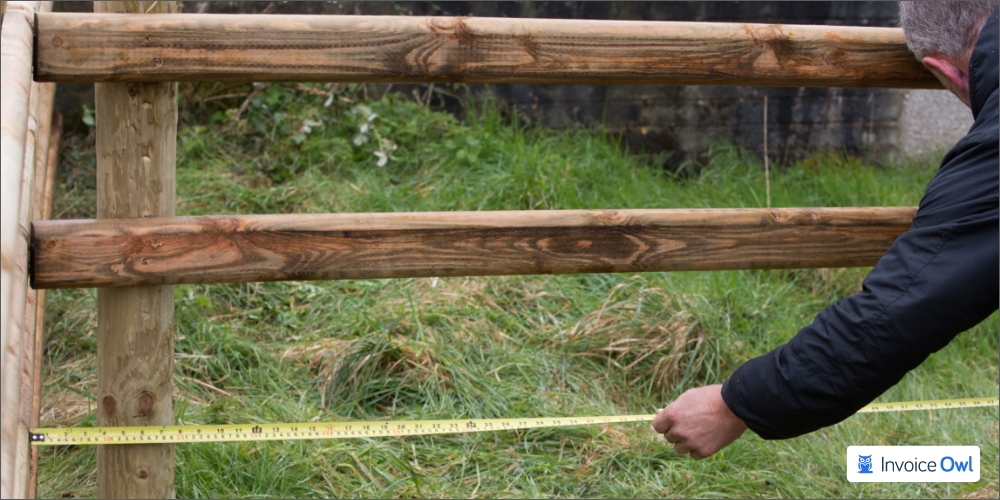
The materials cost will account for the major of the budget. So, before moving ahead with the professional installation work, you must figure out how much materials you need to measure your fencing area.
Locate property lines
If you lay the fence in the wrong property lines, then it's obvious you must remove them, which will cost you. So, to avoid this chaos, check the property line information given in the client's property deed or mortgage package. If this information isn't clear, get the official documentation on where the property border lies.
Locate the barrier
Next, locate the things that could be a barrier to your fencing. This may include trees, other property features, or underground utilities such as electricity, gas, and cable. So, get accurate details from the state's information centers to locate utility lines to clarify.
Always check for underground utilities before digging. Hitting a gas or electrical line can be extremely dangerous and costly.
Make corners of the property with a stake
To ensure this, use tape to connect them and ensure there's no slack between them.
Measure the perimeter
Use the stakes as your guide and measure the perimeter of the fencing area.
4. Estimate material costs
The material costs will account for the major budget, and even a small slip in the calculation can affect the markup. So, the marked-up price must be written on the quote and not the materials at cost.
First, calculate the materials cost, then find out how your markup on those materials.
So, how to estimate the materials cost?
Start by dividing the perimeter by the size of the fencing panels to know how many units you need for the fence.
Try to note every detail in mind as they can significantly add to the material costs.
If you are fixing wood fences, it will require posts, nails or screws, and concrete to set the posts. These are the extras often overlooked. But in fact, would you pay from your pocket for these small kinds of stuff? No, right.
Also, don't forget that about 30% of your post will be buried in the ground.
5. Estimate labor costs

Once you have calculated the material costs, estimating the labor costs is next. Labor costs account for 20 to 35% of your revenue.
Some business owners either try to limit the number of employees or how much time their crew has for this professional installation work. Either way, you do it, ensure you calculate the labor cost accurately.
If you are removing existing fences, you must add the fence removal cost and the labor costs.
How to calculate your labor costs?
First, calculate the labor hours and then the hourly labor cost.
- Labor hours: Multiply the number of hours required to complete the job X the number of employees needed on the job.
- Hourly labor cost: Employee's wages, taxes, worker's compensation, and other employee-related expenses must be included in this part. If you are unsure, then a 20% reliable markup for an hourly labor cost is recommended.
Labor cost = Labor hours X hourly labor cost.
6. Calculate overhead costs
Your overheads include direct and indirect expenses such as employee uniforms, accounting, office rent, insurance, and other tools and software such as Invoiceowl for estimating and invoicing.
As mentioned earlier, these prices must be accounted for. Otherwise, your margin will be eaten by these extra costs.
Though there are multiple ways to calculate an overhead cost, below, you will find a simple one:
- Step 1: Add all your overhead costs for a specific time.
- Step 2: Find your sales or revenue sum for that same time.
- Step 3: Calculate your overhead rate. Divide the overhead cost by the sales for the same time. You will get a decimal value which is your overhead rate.
- Step 4: Now multiply this decimal point by 100 to get your overhead percentage to get the revenue on average you spend on overhead.
You will get a certain number as a result. The number highlights how much is spent for every dollar of your job's cost. So, it is essential to track every dollar spent.
7. Calculate your margins

Now that you have a list of all the potential costs you need to spend on this fencing installation project, calculate the margins. The higher the profit margin, the more money you can make in your business.
How to calculate the margin?
Margin = Net sales revenue - labor, material, and overhead costs.
If the margin is not exciting, you are left with two options:
- Consider the sum of net profits you will make over the month based on other jobs you take.
- Adjust the current price by doing the calculation again with tweaks here and there.
When to Review your Fencing Services Pricing?
Initially, you might have a fixed price and don't spend time coming up with bids for every job. But with time, you must review your fencing services pricing when your business picks up.
It is recommended to take notes on every job site and organize them and use the notes for reference for your next job.
Things that can impact your pricing are
Sometimes you may need to calculate the estimate onsite or in front of the customers and create invoices without any flaws. But as humans, we tend to make errors and take much time to calculate and curate invoices.
To act smart, invest in the best estimating and invoicing software, such as InvoiceOwl. This easy-to-use software creates professional-looking invoices within minutes.
This is how you must calculate the fence estimate and charge correctly for the fencing services you offer your client.
Create Accurate Fence Estimates in a Tap & Win More Jobs!
InvoiceOwl allows you to create professional-looking estimates and invoices with just a tap, making your jobs easier than ever.
Start Your FREE TrialFrequently Asked Questions
To calculate labor cost for fencing, you need two details, one is labor hours, and the other is hourly labor cost.
The formula is:
- Labor hours - Multiply the hours required to complete the fencing installation by the number of employees needed.
- Hourly labor cost - This cost includes employees' wages, taxes, worker's compensation, and other employee-related expenses; everything is included and calculated hourly.
Now multiply the labor cost by the labor hours to get your labor cost.
To calculate the cost of installing a wood fence per foot, you must know the materials cost. The wood material cost ranges from $1 to $15 per foot, and the labor adds $10 to $30 per foot. So overall, the cost of a wood fence costs between $10 and $45 per linear foot for materials and installation.
Fence installation costs for a 1/4 acre yard will require 200 feet of fencing, costing $2600 to $5,000 for labor and materials. However, your pricing solely depends on the type of materials selected.
Different types of fences based on material:
- Wood fence
- Wrought iron fence
- Vinyl fence
- Aluminum fence
- Galvanized steel fence
- Metal fence
Different types of fences include composite fencing, backyard fence, chain link fence, picket fence, wood privacy fence, electric fences, ranch fencing, and horizontal rails.
Conclusion
If the fence installation costs less, it might be appealing to some customers. But for some people, it might translate as cheap value. So, quoting too low will immensely impact your ability to scale your fencing business.
We recommend following the step-by-step guide given here to price the fence installation services.
Related Resources
Can You Charge for an Estimate as a Contractor?
Complex projects involving detailed designs and multiple revisions may incur some charges for estimates. Learn when to charge for an estimate as a contractor.
Read more
How to Price Drywall Jobs: Everything About Drywall Pricing & Estimation
Learn how to price drywall jobs and what factors you should consider as a drywall contractor when estimating drywall costs.
Read more
Are estimates free? Know When Can You Charge for Estimates
Are you stuck between deciding whether to offer free estimates or charging a fee for them? Here are the general guidelines for charging for estimates.
Read more
15 Best Flooring Estimating Software: Complete Guide
Compare the top 15 flooring estimating software solutions. Detailed reviews, pricing, and features to help contractors make informed decisions.
Read more
Estimating Construction Costs 101: Levels, Methods, and Essentials
To estimate the construction cost accurately and earn profit out of it, you must know the 5 levels and the 3 methods of doing it professionally. Let's discuss this in detail.
Read more
How to Bid a Paint Job- Complete Estimation Process
Master bidding for paint jobs with expert insights on pricing, materials, labor, and insurance. Complete guide for painting contractors to boost profitability.
Read more
What is a Quote or Quotation for Contractors?
A price quote can either be a document or verbal communication that gives a fixed price for a project. Learn the rules of sending out a price quote in business.
Read more
What Is Cost Estimation? An Ultimate Guide To Refer
Cost estimation is projecting an approximate cost of a particular job. It is mandatory for all contractors and it helps them win jobs. Read this post and know all about it.
Read moreCan You Charge for an Estimate as a Contractor?
Complex projects involving detailed designs and multiple revisions may incur some charges for estimates. Learn when to charge for an estimate as a contractor.
Read moreHow to Price Drywall Jobs: Everything About Drywall Pricing & Estimation
Learn how to price drywall jobs and what factors you should consider as a drywall contractor when estimating drywall costs.
Read moreAre estimates free? Know When Can You Charge for Estimates
Are you stuck between deciding whether to offer free estimates or charging a fee for them? Here are the general guidelines for charging for estimates.
Read more15 Best Flooring Estimating Software: Complete Guide
Compare the top 15 flooring estimating software solutions. Detailed reviews, pricing, and features to help contractors make informed decisions.
Read moreEstimating Construction Costs 101: Levels, Methods, and Essentials
To estimate the construction cost accurately and earn profit out of it, you must know the 5 levels and the 3 methods of doing it professionally. Let's discuss this in detail.
Read moreHow to Bid a Paint Job- Complete Estimation Process
Master bidding for paint jobs with expert insights on pricing, materials, labor, and insurance. Complete guide for painting contractors to boost profitability.
Read moreWhat is a Quote or Quotation for Contractors?
A price quote can either be a document or verbal communication that gives a fixed price for a project. Learn the rules of sending out a price quote in business.
Read moreWhat Is Cost Estimation? An Ultimate Guide To Refer
Cost estimation is projecting an approximate cost of a particular job. It is mandatory for all contractors and it helps them win jobs. Read this post and know all about it.
Read moreCan You Charge for an Estimate as a Contractor?
Complex projects involving detailed designs and multiple revisions may incur some charges for estimates. Learn when to charge for an estimate as a contractor.
Read moreHow to Price Drywall Jobs: Everything About Drywall Pricing & Estimation
Learn how to price drywall jobs and what factors you should consider as a drywall contractor when estimating drywall costs.
Read moreAre estimates free? Know When Can You Charge for Estimates
Are you stuck between deciding whether to offer free estimates or charging a fee for them? Here are the general guidelines for charging for estimates.
Read more15 Best Flooring Estimating Software: Complete Guide
Compare the top 15 flooring estimating software solutions. Detailed reviews, pricing, and features to help contractors make informed decisions.
Read moreEstimating Construction Costs 101: Levels, Methods, and Essentials
To estimate the construction cost accurately and earn profit out of it, you must know the 5 levels and the 3 methods of doing it professionally. Let's discuss this in detail.
Read moreHow to Bid a Paint Job- Complete Estimation Process
Master bidding for paint jobs with expert insights on pricing, materials, labor, and insurance. Complete guide for painting contractors to boost profitability.
Read moreWhat is a Quote or Quotation for Contractors?
A price quote can either be a document or verbal communication that gives a fixed price for a project. Learn the rules of sending out a price quote in business.
Read moreWhat Is Cost Estimation? An Ultimate Guide To Refer
Cost estimation is projecting an approximate cost of a particular job. It is mandatory for all contractors and it helps them win jobs. Read this post and know all about it.
Read more