
Key Takeaways
- 01Arborists are tree care specialists, also known as 'tree surgeons,' who maintain plant health and safety
- 02ISA certification requires 3 years of experience or a combination of education and work totaling 3 years
- 03Only 7 US states require an arborist license: California, Connecticut, Hawaii, Louisiana, Maine, Maryland, and Rhode Island
- 04The ISA exam consists of 200 MCQs with a 76% passing score requirement
- 05Certified arborists earn over $72k annually, with opportunities to start their own tree care business
Everybody loves plants. Isn't it? And you will make money by being around and taking care of them all day. Lucky you.
"But seriously, is it a good place to be in?" you may be wondering.
Relax. Put this ice over your anxiety: Arborists are in demand, and currently, over 8000 of them are employed in the US alone.
However, to join them as an ISA-certified arborist, you have a journey to make. So today, we will make it easier by showing you exactly how to become an arborist. But first...
What is an Arborist and its Daily Responsibilities?
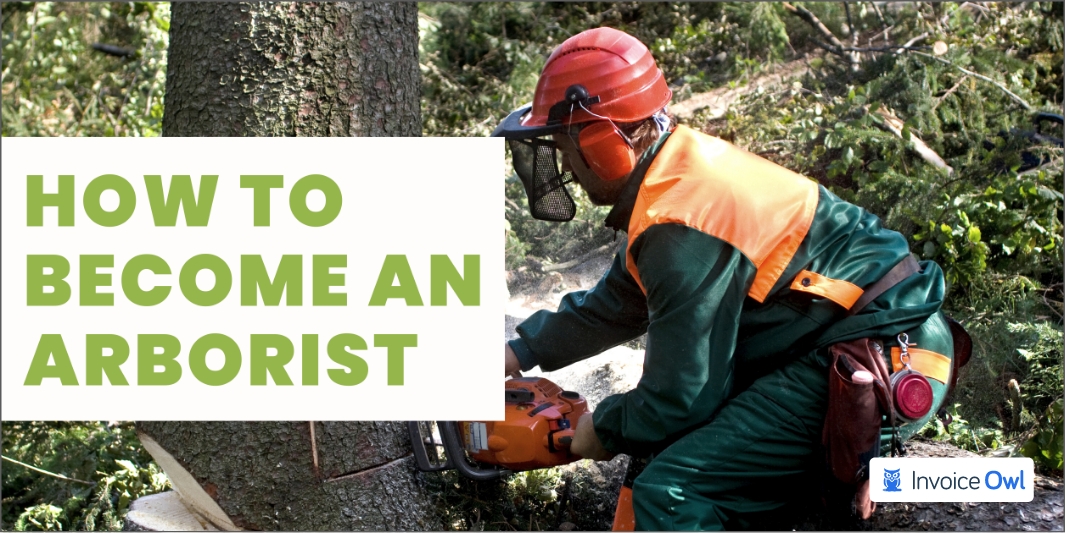
Take an arborist as a doctor of plants. And this is why they are also commonly called "tree surgeons." In other words, they take care of all types of plants, such as - shrubs, vines, and trees.
But how? By ensuring that they stay away from insects or diseases and are in their best shape to live a healthy life. As an arborist, your daily responsibilities may include:
Now that you know what an arborist is, let's have a deeper look at the certification authority.
ISA Arborist Certifications
ISA, aka the International Society of Arboriculture, is a non-profit organization that provides information about this industry and provide professional credentials to arborists.
Types of ISA credentials
Certified Arborist
You need to have some expertise and practical experience in the field of arboriculture. This credential is ideal for you if you are looking to become a generalist rather than a specialist in this industry.
Certified Master Arborist
This certification is for those who have an exceptional level of expertise in the field of arboriculture.
Municipal Specialist
If you specialize in tree care and management in urban and community settings, then this one is for you.
Utility Specialist
This credential is for individuals who specialize in tree care and management in the utility industry.
Tree Worker Climber Specialist
It is for those who possess proficiency in the techniques and safety procedures involved in climbing and working in trees.
Tree Worker Aerial Lift Specialist
As the name suggests, this certification demonstrates the arborist's proficiency in the use of aerial lifts for tree care work.
Tree Risk Assessment Arborist
This is another specialty arborist certification, but for those who have expertise in the science and practice of tree risk assessment.
If you want to find out which credential is right for you, refer to this page from the ISA's official website. It will also provide you with an application guide for each of these credentials.
Required tree care skills
Taking proper tree care can be a sensitive issue. Thus, you are required to have knowledge of the following topics to become an ISA-certified arborist:
Essential Tree Care Skills
| Core Skills | Advanced Skills |
|---|---|
| Tree maintenance | Tree biology |
| Tree planting | Diagnosis and treatment |
| Pruning | Tree risk management |
| Species identification | Safe work practices |
| Soil management | Urban forestry |
It may vary depending upon the type of credential you are aiming for. Here, to keep things simple, we are assuming that you want to be a Certified Arborist.
Ok. We have got the basics covered. Now, let's get to the major part of this topic.
How to Become an Arborist?
Becoming a certified arborist is not too much of a hassle if you know what to do next. So follow these steps one at a time to become an arborist in the US:
Step 1: Get the required education
The goal of this step is to gain a fundamental understanding of arboriculture's principles and procedures through academic education or on-the-job training.
Academic education
You can seek a bachelor's degree in horticulture, forestry, or a related subject. Or you can even opt to enroll in:
- Community college
- Vocational school
- Tree care academy
On-the-job training
A tree care company may require that you at least have a formal education in the form of a high school diploma or GED before employing you for work.
Step 2: See if your state requires a license
Out of 50 US states, 43 don't require an arborist license for jobs involving tree pruning and trimming. That leaves us with these 7:
So, if you live in any of these US states, get your arborist license.
Step 3: Gain work experience
Look out for tree care companies or landscaping companies hiring beginners to gain real-world experience in the arboriculture profession. To be eligible for the ISA-certified arborist exam, you need to:
- Have at least three years of full-time job experience. OR
- Have a combination of education and practical experience equalling 3 years.
One year of full-time experience as an arborist is equal to 1795 work hours.
Step 4: Study for the exam
Now, you need to pass the exam conducted by ISA to get your required credential. So while you gather the minimum required work experience, start studying for the syllabus of the ISA credential you are eyeing for.
But how should you prepare for the exam?
You can start with a study guide issued by ISA for the exam or by enrolling in an online course. Go here to find all the ISA exam study materials.
Step 5: Apply for the exam
Here is how you can apply for the ISA arborist exam:
- Create an account from the MY ISA sign-in page.
- Submit a completed application.
- You will be notified by email about its approval or denial. Or review the application status from the dashboard.
- Upon approval, enroll in either the paper-based or online exam and pay the exam fees at least 12 business days before the exam date.
Step 6: Pass the exam and get your arborist ISA certification
So, are you ready? Ok then, pass the exam to get your credential. The exam consists of 200 MCQs (with 4 options) and provides you with a time of 210 minutes to attend them.
You need to get a score of at least 76% to clear the exam. If you fail to do so, you will need to retake it.
Congratulations. Now you are an ISA Certified Arborist.
Step 7: Maintain your credential
Your credential is valid for 3 years only. To retain, you must recertify using any of these 2 methods:
- Retake and pass the certification exam again. OR
- Accumulate at least 30 continuing education units (CEUs) that are related to the 10 tested domains on the exam and pay the recertification fee.
Bonus step: Start your own tree care business
Arborists make over $72k a year in salary, as per Indeed. But to earn more, many certified arborists choose to start their own tree care business or work as self-employed contractors.
Create and Send Professional Invoices to Your Customers
Try InvoiceOwl for FREE and create professional estimates & invoices in a few simple taps and stand out from other tree businesses!
Start Your FREE TrialFrequently Asked Questions
The pros and cons of choosing to become an arborist are subjective to you. But here is what we have found based on the experience of experts in the tree care industry:
Pros:
- Work outside and stay fit
- Learn about trees and landscapes
- Not having to deal with a lot of people
- Not very stressful
Cons:
- Need to do some dangerous work
- Not very sustainable as you age
- Relatively slower individual growth
- Can feel underpaid
Most arborists work in some dangerous conditions, and thus, you may find yourself having to:
- Climb trees
- Use power tools
- Prune unstable trees with dead branches
- Work near high-power cable lines
Thus, make sure that you always wear protective gear and work with caution.
Mainly, the job duties of an arborist depend on the employer; however, some of the common duties of an arborist include:
- Tree Care
- Tree Planting
- Tree Assessment
- Risk Assessment
- Consultation
- Equipment Maintenance
Conclusion
So, are you prepared to be a tree surgeon? We bet you are because now you are equipped with all the missing pieces of the puzzle to become an arborist.
Start with deciding which of the 7 credentials you want, and then start with each laid-out step as we discussed. Once you become an arborist successfully, all you can do is opt for an estimate and invoice software like InvoiceOwl to make estimates and invoices in just a few minutes.
Related Resources
20 Best Landscaping Websites for Inspiration 2025
Are you searching for inspiring ideas for your landscaping business website? Here are some of the best landscaping websites that appeal to customers.
Read more
10 Best Lawn Care Apps for Contractors in 2025
Managing a lawn care business can be overwhelming without the right tools. Here are the best lawn care apps for contractors to effectively run their businesses.
Read more
6 Best Lawn Care Websites to Get Inspired
Ready to start your lawn care business? Check out the 6 best lawn care websites to build a strong online presence and stand out from the competition.
Read more
How Much to Charge for Snow Removal: A Complete Guide
Don't have an ideas on how to charge your clients for your snow removal services? We have covered major aspects on how much to charge for snow removal.
Read more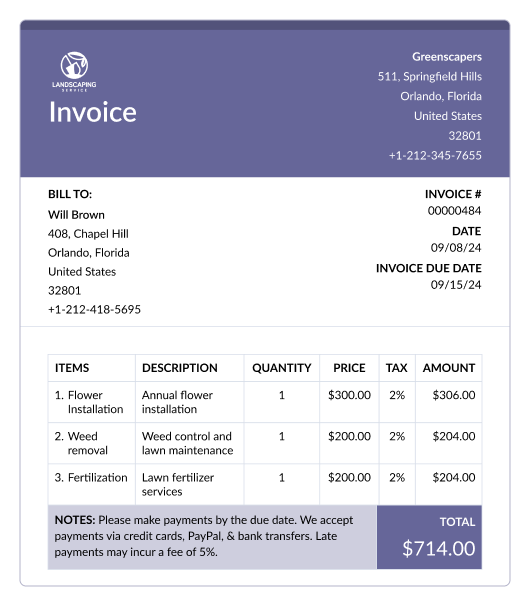
Landscaping Invoice Template
Landscaping Invoice Template
Read more
Lawn Care Invoice Template
Lawn Care Invoice Template
Read more
Snow Removal Invoice Template
Snow Removal Invoice Template
Read more
Tree Service Invoice Template
Tree Service Invoice Template
Read more20 Best Landscaping Websites for Inspiration 2025
Are you searching for inspiring ideas for your landscaping business website? Here are some of the best landscaping websites that appeal to customers.
Read more10 Best Lawn Care Apps for Contractors in 2025
Managing a lawn care business can be overwhelming without the right tools. Here are the best lawn care apps for contractors to effectively run their businesses.
Read more6 Best Lawn Care Websites to Get Inspired
Ready to start your lawn care business? Check out the 6 best lawn care websites to build a strong online presence and stand out from the competition.
Read moreHow Much to Charge for Snow Removal: A Complete Guide
Don't have an ideas on how to charge your clients for your snow removal services? We have covered major aspects on how much to charge for snow removal.
Read moreLandscaping Invoice Template
Landscaping Invoice Template
Read moreLawn Care Invoice Template
Lawn Care Invoice Template
Read moreSnow Removal Invoice Template
Snow Removal Invoice Template
Read moreTree Service Invoice Template
Tree Service Invoice Template
Read more20 Best Landscaping Websites for Inspiration 2025
Are you searching for inspiring ideas for your landscaping business website? Here are some of the best landscaping websites that appeal to customers.
Read more10 Best Lawn Care Apps for Contractors in 2025
Managing a lawn care business can be overwhelming without the right tools. Here are the best lawn care apps for contractors to effectively run their businesses.
Read more6 Best Lawn Care Websites to Get Inspired
Ready to start your lawn care business? Check out the 6 best lawn care websites to build a strong online presence and stand out from the competition.
Read moreHow Much to Charge for Snow Removal: A Complete Guide
Don't have an ideas on how to charge your clients for your snow removal services? We have covered major aspects on how much to charge for snow removal.
Read moreLandscaping Invoice Template
Landscaping Invoice Template
Read moreLawn Care Invoice Template
Lawn Care Invoice Template
Read moreSnow Removal Invoice Template
Snow Removal Invoice Template
Read moreTree Service Invoice Template
Tree Service Invoice Template
Read more