

Key Takeaways
- 01Many states require handyman licenses for projects exceeding certain dollar thresholds (typically $1,000-$10,000)
- 02Licensed handymen can earn up to $58,000/year compared to $42,000 for unlicensed professionals
- 03License requirements vary significantly by state - some require exams and insurance, others have no requirements
- 04Common license requirements include work experience, licensing exams, insurance proof, and registration with labor departments
- 05Understanding your state's specific requirements can help you avoid legal troubles and access higher-paying projects
The average handyman's salary is around $20.49/hour or $42,000/year. But a licensed and experienced handyman can get up to $58,000/year or $28/hour. The handyman industry is great for professionals who want to pursue the profession as their career.
But does a handyman need a license? Not all but a few high-paying handyman services demand a designated license, and the license requirements vary from state to state. Also, if you want to rise the ranks, a license can assist you in scaling your career growth and working on high-paying service requests.
So, let's understand the requirements.
Factors to Determine Whether You Need a License
Determining whether a handyman requires a license or not depends on the scale of the work and the area of business operations.
Many states don't have any criteria for handyman contractors, but multiple states have a specific limit on the project scope to trigger whether you should apply for a handyman license or not.
In Arizona, if you are handling projects over $1,000, you require a professional license, but below that, you don't need a professional handyman license.
Once you are clear with the basic requirements and licensing laws and can fulfill the eligibility criteria set by the state's governing body, you can acquire the required handyman license.
How to Get a Handyman's License?

A few handyman services require licenses you must acquire to operate as a professional handyman in a specific industry. Different states have different requirements for being eligible for a handyman license, but the common steps to complete the requirements are:
Once you cover these basic requirements, you can avail a handyman license irrespective of the state you want to operate in. You can work as an assistant with some handymen or apply for different entry-level jobs at a construction site that can help you gain experience.
You can also apply for vocational college, bachelor's degree, or diploma courses that provide the required theoretical learnings and industry insights to pass the licensing exam. Once you scale your handyman business operations, you can bypass the set limit of project amount or scale that can streamline acquiring a dedicated handyman license.
Handyman License Requirements by State
We have compiled the handyman license requirements based on different states in the country. Have a look.
Alabama
You don't require a state license to work professionally as a handyman in Alabama. Being a handyman contractor, if you want to operate on a project valued over $50,000, you require a license that can be procured from the state's governing authority.
Alaska
A handyman operating in Alaska must hold a license to perform work valued up to $10,000. You can contact the Alaska Division of Corporations Business and Professional Licensing to acquire your general contractor – handyman license. You need to provide proof of property damage insurance and general liability to be eligible for getting the license from the authorities.
Arizona
If you handle projects over $1,000, you must have an Arizona contractors license. Work that is worth less than $1,000 doesn't require a handyman license. It's also known as handyman exemption and is followed in different states. The Registrar of Contractors issues the handyman licenses to professionals. You must provide proof of eligibility by passing a trade, law, and business exam and submitting proof of a bond.
Arkansas
You must procure a home improvement license to operate professionally as a handyman and handle specialty work worth more than $2,000 in Arkansas. The license enables you to take on projects in different services like painting, roofing, and flooring installation.
If you want to increase the scale of your service operations and handle more significant work, you should consider applying for the Arkansas residential remodeler license. You don't need an exam to get the handyman license, but you require proof of worker's compensation insurance and your financial statement.
California
You don't require a special handyman license in California for handling small jobs. But being a handyperson, if you are working on jobs more than $500, then you must have a general contractor's license.
You'll be exempt from the $500 limit if you work on a job request that doesn't become a fixed part of the structure, like building furniture or hanging pictures.
The Contractors State License Board handles the approval for California general contractor license. You can apply for the license once you prove your eligibility with four years of work experience, a contractor's bond of $15,000, and a certificate of insurance. To complete the license requirements, you must also pass the trade, business, and law exams. Contact the governing authorities to clarify the detailed handyman license requirements.
Colorado
Being a handyman in Colorado, you fall under the category of being a general contractor. The state doesn't require a specific license requirement for general contractors, but you should check a few local requirements before starting your work professionally to escape all the troubles. Contact the state's governing authority and streamline your work operations to deliver quality handyman service results.
Connecticut
Handymen don't require a state license to work in Connecticut. But if you are a home improvement contractor that provides permanent changes to a residential property, you should register with the Department of Consumer Protection. It can help you escape legal troubles and ensure that you can take on large-scale projects with ease.
Delaware
The state doesn't require you to become a licensed contractor to operate as a handyman. Being a general contractor, you require a business license to work on projects of more than $50,000. The license can be acquired by registering with the state's governing authorities and used for revenue purposes.
Florida
You don't require a state license while working as a handyman handling miscellaneous non-structural work like minor carpentry, door repairs, paneling, window repair, and tile installation.
But you require a Florida general contractor license if you provide handyman services or operate a handyman service in Florida structural handling work like building, home renovations, and roofing.
The Department of Business and Professional Regulation governs the license issuing. You require four years of experience, workers' compensation insurance in Florida, and liability insurance to fulfill the basic requirement for getting your professional license. You also need to pass the exam organized by the department that checks your skills and expertise in the industry.
Georgia
The state licensing requirements for a handyman in Georgia, apply if you want to handle projects worth more than $2,500. You require a residential-basic contractor license by passing the trade and business and law exam. The Georgia Board of Residential and General Contractors needs to provide a pre-approval that allows them to appear in the exam. You also need to have an experience of at least two years, workers' compensation insurance in Georgia, and proof of general liability insurance.
Hawaii
You need to hold a handyman license in Hawaii if you want to work on jobs where the material and labor cost is more than $1,000 or requires a building permit. Specialty contractor licenses and general building contractor licenses are issued by the Department of Commerce and Consumer Affairs Professional and Vocational Licensing.
The department also requires you to pass a trade, and a business and law exam, show proof of insurance, and have at least four years of experience in the last 10 years.
Idaho
The state doesn't require contractor licensing to operate as a professional handyman. But you must follow a simple registration process to comply with the local regulations set by the Idaho Contractors Board.
Illinois
Running your own handyman business or operating as a general contractor; you don't require a state license to provide your services in Illinois. But many local jurisdictions, including Chicago, have the basic requirements for contractors, and handymen have a general contractor's license.
Indiana
The state doesn't require licensing requirements for general contractors or handymen in Indiana. But you need to pass a few regulation checks at the local level. Contact the local governing authority for the new local operating laws before starting your professional journey as a handyman in Indiana.
Iowa
The state doesn't apply complex license requirement criteria for normal handyman professionals. But for handyman business startup guide in the state, you must consider a few registration processes. Check with the Iowa Division of Labor to register as a contractor and start with the professional handyman business operations.
Kansas
You don't require a professional state license to work in Kansas. But as a contractor, you must follow a few local-level regulations to bypass the legal complications during your handyman project management. Check with the local governing authorities in Kansas before starting your work to complete the required formalities.
Kentucky
Being a general contractor or handyman in Kentucky, you don't require a professional license. Ensure you complete the local requirements with the local governing authority before you begin work to ensure you comply.
Louisiana
The state handyman license requirements include passing a trade and a business and law exam, proof of insurance, and other basic documentation. A special handyman license is required if you handle home improvement or residential projects worth more than $7,500. You also need home improvement registration with the Louisiana State Licensing Board for Contractors for handling projects valued between $7,500 and $75,000.
Maine
You don't require a contractor or handyman license to operate in the state. But there are some local-level regulations that you must adhere to. You can contact the local governing authorities, who can provide you with more clarity and ensure that you bypass future legal complications.
Maryland
You need a home improvement license to work as a handyman in Maryland. You can apply for the license with the Department of Labor, Licensing, and Regulation. Based on the department's information, the license will cover conversions, improvement, modernization, additions or alterations, remodeling, replacement, or repair of a residential building.
You must provide two years of experience in the home improvement industry and a certificate of insurance. The department conducts an exam related to business and law that you need to pass to get your license.
Massachusetts
If you are into home repair jobs and property repairs, then you don't require a state license in Massachusetts. But you need to get a home improvement contractor registration. The governing authorities don't conduct a dedicated exam for the registration process. You need to pay the required registration fees to complete the required process.
But you need a Construction Supervisor License if you want to switch towards structural work like renovation or larger building projects to existing structures. An unlicensed handyman cannot handle large-scale projects.
There are different licenses provided by the state's governing body, depending on the project's scope:
- "Restricted" licenses: Work on one-to-two-family homes
- "Unrestricted" licenses: Work on structures up to 35,000 cubic feet
The governing departments demand a minimum experience of three years in the industry and passing results for the special exam to be eligible for a license.
Michigan
Being a handyman in Michigan, you need a professional Maintenance and Alteration Contractor License if you handle different jobs like carpentry, laying concrete, painting and tiling. But if you are focused on small-scale and minor repair jobs, there's no requirement for you to buy a special license.
The eligibility criteria for the license include 60 hours of educational courses and passing an exam conducted by the governing authorities to test your theoretical knowledge.
Minnesota
You need a residential remodeler license if you operate on existing structures and make more than $15,000 per year. Also, the contractors who build new structures require a Residential Building License that helps them operate legally in the state. The Department of Labor and Industry in Minnesota handles the license issuing and ensures that the licensed contractors comply with the basic requirements.
If you only provide handyman services in one specialty skill area like excavation, masonry, carpentry, exterior finishing, interior finishing, drywall, and plaster or general installation, you don't require a special license.
You need to show proof of worker's compensation and liability insurance and pass the special exam to be eligible for the license.
Mississippi
You don't require a handyman license in Mississippi until you want to handle residential job projects worth $10,000. You can apply for a Residential Remodeling license for large-scale handling projects that is issued by the State's Contractor Licensing Board. The governing authorities will conduct a residential trade and the business and law exam you must clear to avail of your special license. Show the proof of worker's compensation and general liability insurance to the Mississippi Contractor Licensing Board to finalize the license procurement.
Missouri
You don't need a professional state-approved license to work as a handyman or general contractor to work in Missouri. But still, you can contact the local governing authorities to clarify the local handyman license requirements to ensure that you comply with the regulations.
Montana
Handyman or other contractors aren't required to hold a license to operate in Montana. But if you have your own business and employees, you need to register with the Department of Labor and Industry. You can show proof of your workers' compensation insurance to the Contractor Registration Unit of the department. But if you don't have employees, you are not required to register with the governing authorities.
Without a license, you can handle different service tasks, including electrical, repair, or maintenance.
Nebraska
You can operate as a professional handyman in Nebraska without a license. But you must register with the Nebraska Department of Labor.
The requirement is not specific to handyman contractors but applies to all subcontractors, general contractors, or people who perform alterations, construction, additions, installations, renovations, or repairs.
Nevada
As a handyman, you need a contractor's license to work on projects worth more than $1,000 or require a building license. The state applies handyman exemption for work less than $1,000. The Nevada Contractors Board handles the issuing of the licenses and has set minimum eligibility criteria to avail of the license.
You must provide four years of work experience as a foreman, supervising employee, journeyman, or contractor. The department can substitute up to three years of experience if you have acquired education from an approved college.
You also need to pass a trade, business, and law exam and provide proof of insurance that can fulfill the basic requirements for a handyman license.
New Hampshire
You don't require a professional state license to operate in New Hampshire. You only require licenses if you perform electrical, plumbing, or asbestos abatement work.
The state governing authority has lenient laws that can provide you the freedom to operate as a handyman contractor and deliver a quality customer experience to your customers.
New Jersey
Being a home improvement contractor or a handyman, you don't require a professional license to work in New Jersey. But remember, you must register with the New Jersey Division of Consumer Affairs to avoid future legal issues from the governing authorities.
New Mexico
Being a general contractor or a handyman, you need a professional state license to work. The type of niche you want to operate in defines your category to acquire the license.
You can be classified as a GB-98 general building contractor or a GB-2 residential contractor.
Both classifications have different eligibility criteria:
- Residential classification: 2 years of experience required
- General building classification: 4 years of experience required
- Both classifications require passing trade and business and law exams
New York
The state doesn't have licensing requirements for a handyman or general contractor. But there are a few local regulations and laws that you must check before starting your service operations in the state.
You can contact the license requirements with the local government to ensure you have the fundamentals covered.
Texas
There is no state handyman license requirement for handymen in Texas. You must check the local regulations to become a licensed handyman.
If you run a small business, you need to register your handyman service business with the local county clerk's office to avoid legal hiccups.
Different major Texas cities have licensing rules and special permits for general contractors that you can check and abide by based on your work niche.
These are the leading states with individual handyman licensing requirements. Based on your area of operations, you can fulfill the basic requirements and initiate the handyman license procurement process.
Once done, you can deliver quality handyman service to your clients to increase your profits and revenue. But you also need a professional account management system to maintain a positive cash flow and deliver a professional experience to your clients or leads with your business invoices and estimates.
Are You a Professional Handyman? We Got You Covered!
InvoiceOwl helps you create professional estimates and invoices in real-time in just a few clicks. Manage your handyman business finances effortlessly with our industry-leading software.
Start Your FREE TrialFrequently Asked Questions
No. North Carolina doesn't require a professional license for a handyman. You can get a contractor license once you have experience, but there are no restrictions on working as a handyman in the state.
A handyman can perform different small-scale and minor service works without a license. But if you want to scale your service operations, you must apply for a professional handyman license to provide you with the right platform to scale.
States like California, Nevada, Arizona, and Hawaii have relatively strict handyman license requirements with specific dollar thresholds ranging from $500 to $1,000. These states typically require exams, insurance proof, and work experience documentation.
The cost varies by state but typically includes exam fees ($50-$300), insurance costs (varies by coverage), bonding fees ($100-$500), and registration fees ($50-$200). Overall, you should budget $500-$2,000 for the initial licensing process in most states.
It depends on the state and the type of service. Some states allow general handyman work under one license, while others require specialty licenses for electrical, plumbing, HVAC, or other specific trades. Always check your state's requirements for the specific services you plan to offer.
Related Resources

Maximize Your Margins With Profitability Tips for Appliance Repair Businesses
Discover strategies to increase profitability in your appliance repair business and boost your margins with essential tips for success.
Read more
Essential Appliance Repair Tools: Look What You Need to Get the Job Done
Get the latest and most essential appliance repair tools and equipment for technicians in 2026. Find everything you need to get the job done right.
Read more
Best Appliance Repair Apps
Do you want to make your appliance repair more productive? Here are the best appliance repair apps that help technicians work smarter and more efficiently.
Read more
10 Best Handyman Apps in 2026
Go through the top 10 handyman apps you can choose for your handyman service business management and remove the inefficiencies from your operations.
Read more
California Handyman License: A Complete Guide
Have you decided to become a professional handyman in California? Check this blog and explore the step-by-step process of obtaining a handyman license.
Read more
How to Get Florida Handyman License? A Complete Guide
Are you planning to become a handyman in Florida? Herein you will find a complete guide on how to get a handyman license in Florida. Read more information.
Read more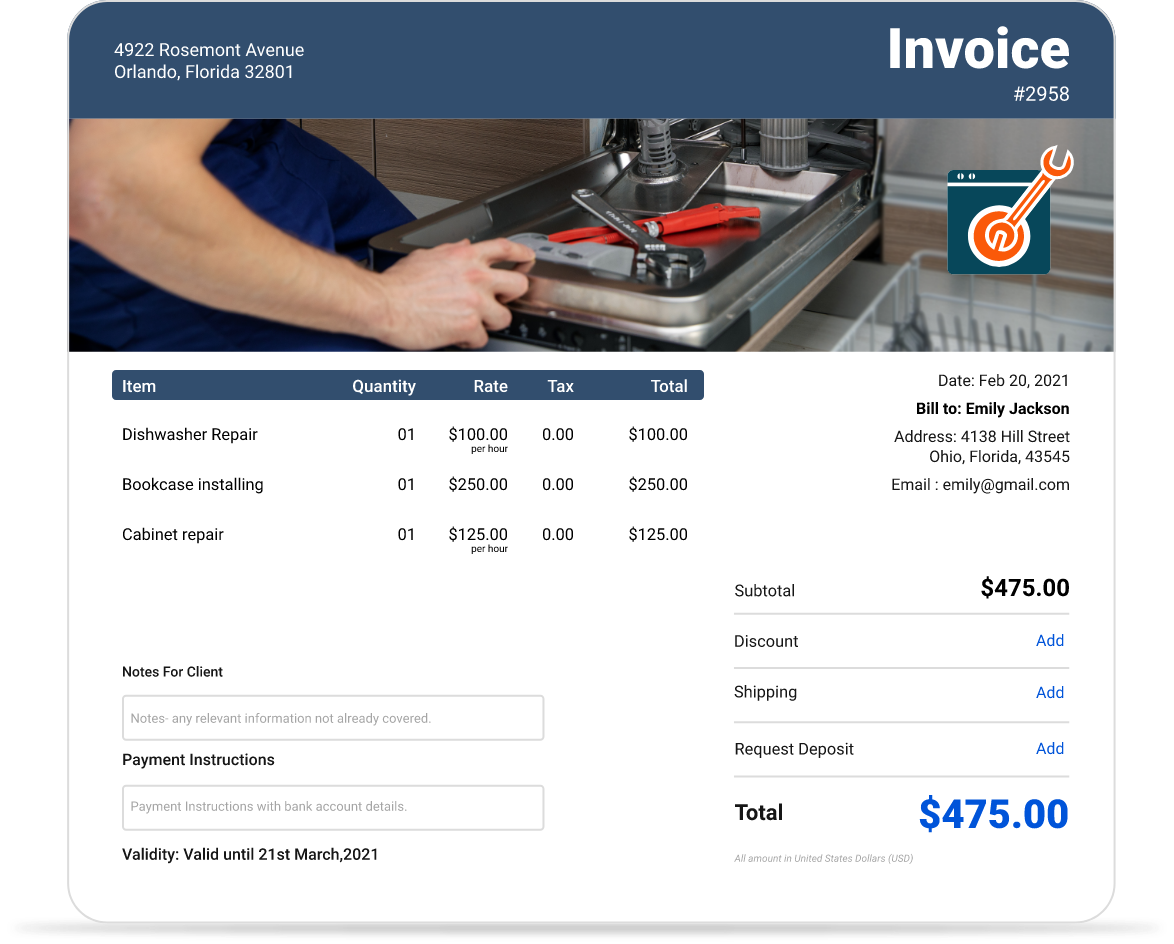
Appliance Repair Invoice Template
Appliance Repair Invoice Template
Read more
Auto Repair Invoice Template
Auto Repair Invoice Template
Read moreMaximize Your Margins With Profitability Tips for Appliance Repair Businesses
Discover strategies to increase profitability in your appliance repair business and boost your margins with essential tips for success.
Read moreEssential Appliance Repair Tools: Look What You Need to Get the Job Done
Get the latest and most essential appliance repair tools and equipment for technicians in 2026. Find everything you need to get the job done right.
Read moreBest Appliance Repair Apps
Do you want to make your appliance repair more productive? Here are the best appliance repair apps that help technicians work smarter and more efficiently.
Read more10 Best Handyman Apps in 2026
Go through the top 10 handyman apps you can choose for your handyman service business management and remove the inefficiencies from your operations.
Read moreCalifornia Handyman License: A Complete Guide
Have you decided to become a professional handyman in California? Check this blog and explore the step-by-step process of obtaining a handyman license.
Read moreHow to Get Florida Handyman License? A Complete Guide
Are you planning to become a handyman in Florida? Herein you will find a complete guide on how to get a handyman license in Florida. Read more information.
Read moreAppliance Repair Invoice Template
Appliance Repair Invoice Template
Read moreAuto Repair Invoice Template
Auto Repair Invoice Template
Read moreMaximize Your Margins With Profitability Tips for Appliance Repair Businesses
Discover strategies to increase profitability in your appliance repair business and boost your margins with essential tips for success.
Read moreEssential Appliance Repair Tools: Look What You Need to Get the Job Done
Get the latest and most essential appliance repair tools and equipment for technicians in 2026. Find everything you need to get the job done right.
Read moreBest Appliance Repair Apps
Do you want to make your appliance repair more productive? Here are the best appliance repair apps that help technicians work smarter and more efficiently.
Read more10 Best Handyman Apps in 2026
Go through the top 10 handyman apps you can choose for your handyman service business management and remove the inefficiencies from your operations.
Read moreCalifornia Handyman License: A Complete Guide
Have you decided to become a professional handyman in California? Check this blog and explore the step-by-step process of obtaining a handyman license.
Read moreHow to Get Florida Handyman License? A Complete Guide
Are you planning to become a handyman in Florida? Herein you will find a complete guide on how to get a handyman license in Florida. Read more information.
Read moreAppliance Repair Invoice Template
Appliance Repair Invoice Template
Read moreAuto Repair Invoice Template
Auto Repair Invoice Template
Read more