

Key Takeaways
- 01General contractors typically charge 7-15% for small projects and 20-25% for larger projects
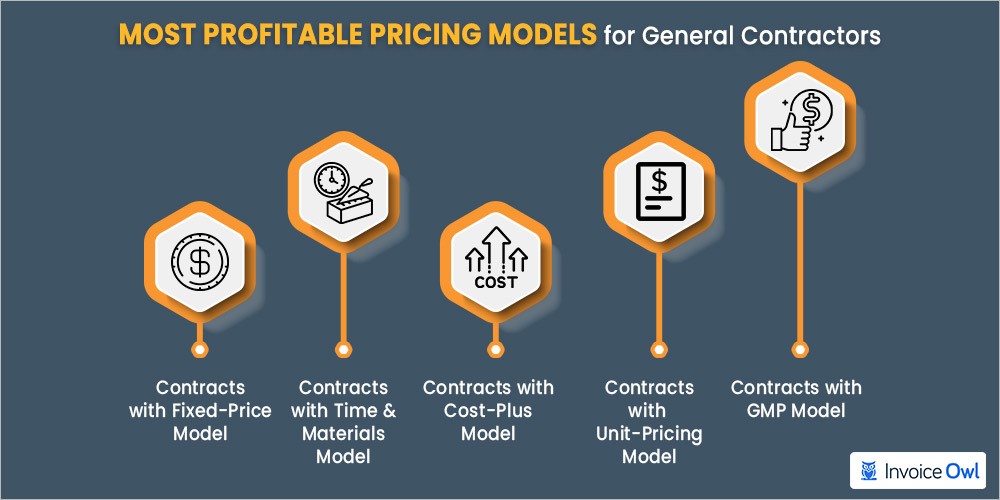
- 02Five main pricing models exist: Fixed-Price, Time & Materials, Cost-Plus, Unit-Pricing, and GMP
- 03Fixed-price contracts minimize client risk but require well-defined project scope
- 04Time & Materials models offer flexibility for projects with uncertain scope
- 05Choosing the right pricing model protects you from undercharging or overcharging clients
Whether it is a basic remodeling or an elaborate construction project, a general contractor cannot afford to go wrong when estimating the project cost. Each building project has its unique requirements, overhead costs, and subcontractor labor costs, each quotation must be unique, making it a hectic process.
Thankfully, there are various general contractor pricing models contractors can rely on to optimize profits and mitigate risks—all while providing the best construction services, exceeding the client's quality expectations.
Table of Content
Here's a contractor pricing guide to make the construction estimating process a bit simpler and more profitable for you. But before we start exploring different pricing methods for your next construction contract, let's first understand what a construction contract is.
What is a Construction Contract?
A construction project, regardless of its size and scope, tends to involve more than one stakeholder, such as general contractors, clients, subcontractors, engineers, designers, architects, and suppliers. A construction contract is drafted to protect each stakeholder's interest.
Hence, by definition, a construction contract is a legally binding document between all the involved parties that:
- Specifies project requirements, timelines, and the scope of the project in detail
- Defines roles and responsibilities of all the stakeholders
- Identifies and distributes risks among the parties involved
- Minimizes project uncertainties
- Provides total construction project cost information, including the payment cycles and stages
- Protects rights and interests of everyone involved
How Much Does a General Contractor Charge?
In most cases, general contractors charge a percentage of a project's total construction costs. For small projects, the pricing may be between 7 - 15% of the total project costs, and it may rise to 20-25% for larger projects.
Since the cost of the project determines contractor fees, let's look at some of the several factors that influence construction project cost:
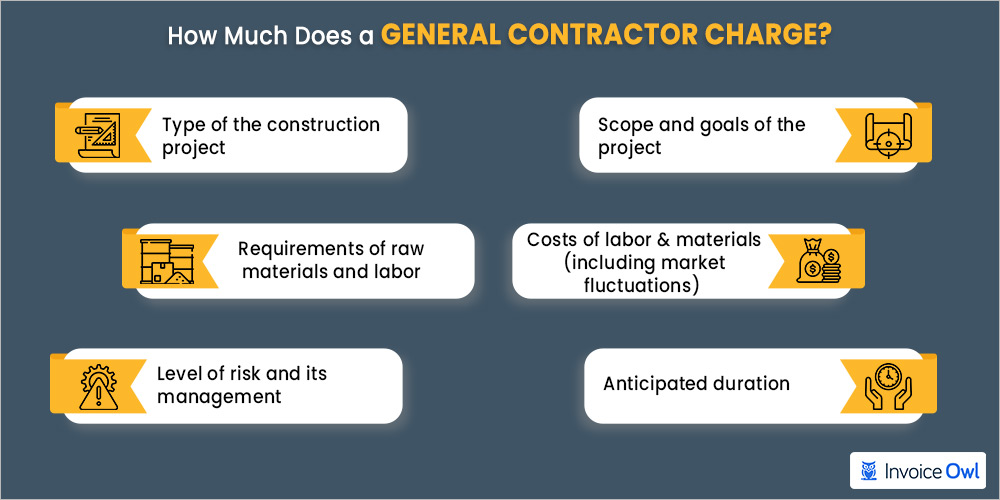
- Type of the construction project
- Scope and goals of the project
- Requirements of raw materials and labor
- Labor cost and materials cost (including market fluctuations)
- Level of risk and its management
- Anticipated duration
- Zip code of your company (location)
The Most Profitable Pricing Models for General Contractors
Many construction companies have their unique contractor pricing methods. However, here are five pricing models widely used in the construction industry:
Fixed-Price Contract Model
In a flat rate, lump sum, or fixed-price model, the general contractor quotes a fixed fee for all the construction services agreed upon with the client. Contractors estimate the project cost on the basis of project scope, detailed construction drawings, and any additional specifications. They then sum up the overhead expenses and revenue to calculate the aggregate costs. It's vital to note that the labor and material costs are usually also included in fixed-price contracts.
Most contractors envisage potential delays in the timeline while drawing up a fixed-fee contract type. This helps cover up for the sudden zero activity days instead of being in a position to ask for timeline extensions. The contractor bears all the risk in fixed-pricing contracts, and the project cost often reflects the perceived risks.
Ideal For: Projects with a well-defined scope and specifications as it helps general contractors tender accurate estimates.
Lump-Sum Contract: Pros and Cons
| Pros | Cons |
|---|---|
| Less management resources, paperwork, and accounting processes are required leading to lower administrative costs for both parties | Rigidity in project scope and specifications |
| Little financial risk for the client as the cost overruns fall under the contractors' responsibilities | Possibility for the client to be billed higher than the average cost as contractors don't have to define how they resulted in pricing for materials, labor, or project risks |
| Limited supervision by the client | Unexpected changes or market price fluctuations could run into the contractors' profits |
| Payments at mutually-agreed milestones |
Time & Materials Contract Model
In Time and Materials or (T&M) contracts, a general contractor is entitled to receive reimbursements towards the costs of materials. Also, the payments in this construction pricing model are calculated per hour or daily and often include additional business expenses that may be incurred at the commencement of the project.
What's vital to note is that T&M pricing rates require you to include the aggregate costs while classifying them into direct, indirect, mark-up, and overhead expense costs.
Ideal For: Projects that may not have a well-defined scope and specifications. It is also suitable for small-scale projects and projects with a strict timeline.
Time and Materials Contract: Pros and Cons
| Pros | Cons |
|---|---|
| Flexible payments structure | Difficult to monitor the time efficiency and cost of materials |
| Expense coverage for potential roadblocks, sudden delays, and changes in the work scope | Tracking cost of materials is time-consuming |
| Hassle-free negotiations to finalize the hourly rate | Potential likelihood for clients to run out of money before the project is completed |
| Simpler to chalk out rules for material cost estimates | No incentive for timely or early completion of projects |
| Minimization of risks for clients as they can set up definite duration or price cap for projects |
Cost-Plus Contract Model
With a cost-plus or cost-reimbursement price model, the client agrees to pay the general contractors for total project costs plus an agreed amount as profits. The profit margin in this scenario is usually calculated as an agreed percentage of the overall project cost.
In this method of contractor pricing, contractors must provide proof of direct and indirect costs and other related expenses.
Ideal For:Projects where it's likely that actual costs may be far less than earlier anticipated.
Cost-Plus Contract: Pros and Cons
| Pros | Cons |
|---|---|
| Coverage for the cost of additional material or labor required for the execution of the project changes | The client bears all the risks in this type of price agreement |
| Flexible in negotiations | Client heavily involved in the project's administration |
| Hassle-free negotiations to finalize the hourly rate | No incentive for efficiency to lower labor costs |
| Inaccuracies in initial contractor bid don't lead to losses | Difficult to track average cost and expenses |
| No risk for construction companies in case of increase in costs of project execution |
Unit-Pricing Contract Model
Also known as measurement contracts, this contract model is implemented by splitting entire projects into individual units. The contractor then provides the client with estimates for each of these units rather than estimating the cost of the entire project.
In other words, contractors charge for the independent tasks of the projects, and as a result, the exact cost of the project is unknown until project completion. However, the client can estimate the possible total cost by summing up the unit prices. This type of costing method is mainly used by construction companies and federal agencies.
Ideal For:Projects with some uncertainty about the quantity of work required from the start. It is also beneficial to projects with repetitive work scope or high dependency on the cost of materials.
Unit-Pricing Contract: Pros and Cons
| Pros | Cons |
|---|---|
| Flexibility in managing differences between actual and planned work | Difficult to determine the overall cost of work |
| Increased transparency in the evaluation of each unit's costs | Chances of inflated general contractor fees |
| Simplified invoicing process due to pre-determined unit price | Client comparison and verification of units prices may slow down the payment cycle |
| Inaccuracies in initial contractor bid can be amended | The client bears the maximum risk |
| Easy inclusion of supplementary work as add-on units to the project scope, enabling uncomplicated management for the construction manager and the client |
GMP Contract Model
A GMP or Guaranteed Maximum Price model for construction contracts empowers the property owner (the client) to put a price limit on the general contractor's services. In this case, the contractor bears the liability even if the project requires additional work, labor, material costs, or overhead expenses.
Since the contractor bears any added expense in the GMP pricing model, it becomes crucial for the general contractors to come up with accurate estimates and refrain from undercharging or overcharging clients for their contracting services. The risk in this general contractor pricing model shifts to the contractor.
Ideal For: Projects with a clearly defined work scope with fewer uncertainties or changes.
GMP Contract: Pros and Cons
| Pros | Cons |
|---|---|
| Involves a rapid bidding process for contractors | Implies more risks on contractors and increases the possibilities of running into losses |
| Offers additional opportunities to obtain more finances as the projects have a guaranteed maximum price limit | Includes a relatively lengthy negotiation process as clients may take more time to review quotes |
| Incentivise contractors to cut costs on overheads | Higher chances of contractors quoting a higher maximum price in their estimate to cover for potential rising costs and unforeseen events |
| Encourages contractors to complete the work before schedule | |
| Relieves clients of the burden of cost overruns |
Every reputable contractor insists on understanding the project requirements to decide the best pricing method for their construction projects. The ideal pricing model ensures you're adequately compensated for your services without compromising on quality.
Importance of Choosing the Right Contractor Pricing Method
Without the right costing model, contractors would end up undercharging or overcharging clients. Every reputable contractor insists on understanding the project requirements to decide the best pricing method for their construction projects.
The ideal pricing model thus ensures contractors are adequately compensated for their services without compromising on quality. It also acts as a safety net, protecting them against unreasonable liabilities that may arise in the future.
Simplify Your Invoicing and Get Paid Faster
InvoiceOwl helps contractors create accurate estimates and professional invoices in less than a minute. Save time, ensure accuracy, and get paid faster.
Start Your FREE TrialFinal Thoughts
As a general contractor, it's impossible to use the same estimates for all project inquiries. Therefore, it is imperative to carefully evaluate every project to quote an appropriate price for each proposal. And that's when knowing the right contractor pricing model to implement comes in handy.
With lots of different costing methods available to suit diverse project requirements, a contractor must review the project requirements and client expectations to determine which model would be most profitable for them without compromising on quality.
When sending your invoices, it's a good idea to ensure clients know what they are paying for. And one way to ensure clients understand your invoice is by using a trusted estimating and invoicing software solution like InvoiceOwl.
InvoiceOwl helps contractors create free estimates and invoices in less than a minute and send them to multiple recipients. InvoiceOwl simplifies the estimation process, helps achieve unparalleled accuracy, and saves your time. And with multiple customizable invoice templates specifically designed for contractors, this invoicing solution saves you the time and effort required to create invoices and estimates from scratch.
Enjoy hassle-free invoicing today! Start your FREE Trial now!
Related Resources
Construction Profit Margins: How to Track and Increase it
Learn how to track and increase construction profit margins with expert strategies. Maximize profits and ensure sustainable business growth. Start today.
Read more
7 Practical Strategies to Make Most Profit in Construction
Facing tough times in your construction business? Use these strategies to skyrocket your business profit without losing your old and new customers. Understand the reason behind calculating exact service costs.
Read more![How to Make Money in Construction Business [10 Key Strategies]](/images/2022/08/How-to-Make-Money-in-Construction-Business.jpg)
How to Make Money in Construction Business [10 Key Strategies]
Discover useful tips on how to make money in the construction business. We've included excellent techniques to cut costs, and increase profitability.
Read more![How to Price Commercial Lawn Care [Contractors' Guide]](/images/2022/09/how-to-price-commercial-lawn-care.jpg)
How to Price Commercial Lawn Care [Contractors' Guide]
Learn how to price commercial lawn care business by following our comprehensive guide to price the commercial lawn care contract.
Read more
Best Invoicing Software for Small Businesses (2025)
Compare the top invoicing software solutions for small businesses and contractors. Find detailed reviews, pricing, features, and user feedback to choose the right tool for your needs.
Read more
15 Best Flooring Estimating Software: Complete Guide
Compare the top 15 flooring estimating software solutions. Detailed reviews, pricing, and features to help contractors make informed decisions.
Read more
How to Bid a Paint Job- Complete Estimation Process
Master bidding for paint jobs with expert insights on pricing, materials, labor, and insurance. Complete guide for painting contractors to boost profitability.
Read more
What is a Quote or Quotation for Contractors?
A price quote can either be a document or verbal communication that gives a fixed price for a project. Learn the rules of sending out a price quote in business.
Read moreConstruction Profit Margins: How to Track and Increase it
Learn how to track and increase construction profit margins with expert strategies. Maximize profits and ensure sustainable business growth. Start today.
Read more7 Practical Strategies to Make Most Profit in Construction
Facing tough times in your construction business? Use these strategies to skyrocket your business profit without losing your old and new customers. Understand the reason behind calculating exact service costs.
Read moreHow to Make Money in Construction Business [10 Key Strategies]
Discover useful tips on how to make money in the construction business. We've included excellent techniques to cut costs, and increase profitability.
Read moreHow to Price Commercial Lawn Care [Contractors' Guide]
Learn how to price commercial lawn care business by following our comprehensive guide to price the commercial lawn care contract.
Read moreBest Invoicing Software for Small Businesses (2025)
Compare the top invoicing software solutions for small businesses and contractors. Find detailed reviews, pricing, features, and user feedback to choose the right tool for your needs.
Read more15 Best Flooring Estimating Software: Complete Guide
Compare the top 15 flooring estimating software solutions. Detailed reviews, pricing, and features to help contractors make informed decisions.
Read moreHow to Bid a Paint Job- Complete Estimation Process
Master bidding for paint jobs with expert insights on pricing, materials, labor, and insurance. Complete guide for painting contractors to boost profitability.
Read moreWhat is a Quote or Quotation for Contractors?
A price quote can either be a document or verbal communication that gives a fixed price for a project. Learn the rules of sending out a price quote in business.
Read moreConstruction Profit Margins: How to Track and Increase it
Learn how to track and increase construction profit margins with expert strategies. Maximize profits and ensure sustainable business growth. Start today.
Read more7 Practical Strategies to Make Most Profit in Construction
Facing tough times in your construction business? Use these strategies to skyrocket your business profit without losing your old and new customers. Understand the reason behind calculating exact service costs.
Read moreHow to Make Money in Construction Business [10 Key Strategies]
Discover useful tips on how to make money in the construction business. We've included excellent techniques to cut costs, and increase profitability.
Read moreHow to Price Commercial Lawn Care [Contractors' Guide]
Learn how to price commercial lawn care business by following our comprehensive guide to price the commercial lawn care contract.
Read moreBest Invoicing Software for Small Businesses (2025)
Compare the top invoicing software solutions for small businesses and contractors. Find detailed reviews, pricing, features, and user feedback to choose the right tool for your needs.
Read more15 Best Flooring Estimating Software: Complete Guide
Compare the top 15 flooring estimating software solutions. Detailed reviews, pricing, and features to help contractors make informed decisions.
Read moreHow to Bid a Paint Job- Complete Estimation Process
Master bidding for paint jobs with expert insights on pricing, materials, labor, and insurance. Complete guide for painting contractors to boost profitability.
Read moreWhat is a Quote or Quotation for Contractors?
A price quote can either be a document or verbal communication that gives a fixed price for a project. Learn the rules of sending out a price quote in business.
Read more